

Telegram Ads gives businesses a way to reach people while they are already spending time inside Telegram. The platform itself is relatively simple to understand, but running an effective campaign is not just a matter of writing a short Sponsored Message and choosing a budget.
In practice, the harder questions come afterwards. Is the ad appearing in the right context? Does the message make sense to the people seeing it? Is the channel or bot strong enough to hold their attention? And can the business tell whether those users eventually became qualified leads or customers?
That is the more useful way to think about Telegram Ads in 2026. The ad is not the campaign. It is the first step in a Telegram-native acquisition journey.
This guide explains how Telegram Ads works, where it fits in a paid-media strategy, how targeting and messaging should be approached, what advertisers should measure, and how to diagnose campaigns that are generating activity without producing meaningful business results.
What Are Telegram Ads?
Telegram Ads is Telegram’s official advertising platform for distributing Sponsored Messages.
In Telegram’s standard self-service Ad Platform, Sponsored Messages are documented for public one-to-many channels with at least 1,000 subscribers.
Telegram’s broader privacy documentation also describes advertising in other parts of the ecosystem, including bots, Stories and public search. These placements should not automatically be assumed to use the same buying, targeting or destination rules as the classic self-service channel-based Sponsored Message product.
Advertisers should therefore verify the inventory and controls available in the advertising account or buying route they are actually using before planning a campaign around a specific placement.
Telegram Ads should also be separated from general Telegram marketing.
A business can run its own channel, build a community, use bots, publish content organically or arrange promotion directly with a channel owner. All of those activities can belong to a Telegram strategy, but they are not the same thing as running ads through Telegram’s official advertising platform.
If your business is still deciding how Telegram fits into the wider marketing mix, HDM’s Telegram marketing guide covers that broader strategic question.
For paid acquisition, a useful mental model is:
Paid reach → Telegram destination → engagement → qualification or conversion
The Sponsored Message creates the initial contact. The quality of the destination and the journey afterwards determines whether that contact becomes commercially useful.
How Telegram Ads Work
The standard self-service Telegram Ad Platform allows advertisers to create a Sponsored Message, choose eligible placements, set a CPM and campaign budget, and monitor campaign activity.
CPM means cost per 1,000 views.
Telegram’s self-service documentation states that Sponsored Messages can run in eligible public channels with at least 1,000 subscribers. Advertisers can also select specific eligible channels in which they want their ads to appear.
One of the biggest differences compared with many other paid-media platforms is the destination.
In the documented self-service Sponsored Message workflow, links must lead to a Telegram channel or bot using a Telegram destination such as t.me/… or @…. The classic Sponsored Message workflow is therefore not designed as a conventional direct-to-website traffic campaign.
That changes how the campaign should be planned.
Instead of assuming:
Ad → Website → Conversion
a Telegram-native journey may look more like:
Ad → Channel or Bot → Engagement → Next Step
Telegram also allows advertisers to work from a personal account or create an Organization linked to a Telegram group or channel. This can make campaign administration easier when several administrators need to manage advertising.
Another operational detail matters when structuring tests. Telegram allows advertisers to update elements such as ad content and CPM, but targeting parameters are not simply changed on the existing ad. A new or similar ad should be created when a different targeting setup is required.
That makes campaign organization more important than it first appears. If different channel contexts or propositions are being tested, separating them clearly from the beginning makes later analysis easier.
The core self-service mechanics can be summarized as follows:
| Element | What advertisers should know |
| Buying model | CPM, based on 1,000 views |
| Core self-service placement | Eligible public Telegram channels with 1,000+ subscribers |
| Direct destination | Telegram channel or bot |
| Documented targeting | Selection of specific eligible public channels |
| Campaign management | Budget, CPM, ad content and performance monitoring |
| Primary acquisition outcomes | Channel joins or bot starts, depending on the destination |
Telegram also states that it does not use the contents of private chats or users’ contact lists to show ads.
Who Should Use Telegram Ads?
Telegram Ads is not a channel that every business needs.
The better question is whether Telegram already makes sense in the customer journey.
If your audience follows specialist Telegram channels, your business already has a useful Telegram destination, or a bot can help educate and qualify users, paid acquisition can become a logical extension of that system.
This is particularly relevant for businesses where the customer does not necessarily convert after one interaction.
A specialist consultancy, professional training company, research publisher or community-led business may benefit from bringing users into an environment where the relationship can continue over time.
The same logic applies to niche communities. Telegram can be attractive when a target audience is concentrated around particular subjects and regularly follows channels related to those interests.
That does not mean a large Telegram audience automatically creates a strong use case.
A business with no active channel, no useful bot and no meaningful reason for users to remain inside Telegram may be better served elsewhere.
The same is true when the only commercial objective is to drive immediate traffic to an external website. In that situation, another paid channel may provide a more direct route.
For example, a local service company trying to capture people who are actively searching for a provider may find Google Search more appropriate.
A consumer brand whose buying journey depends heavily on visual discovery may prefer Meta.
Telegram belongs in the media mix when the customer journey supports it, not simply because the platform offers advertising.

Telegram Ads Strategy: Before You Launch
A large share of Telegram Ads problems start before the campaign goes live.
The advertiser selects channels, writes a Sponsored Message and sets a budget, but the journey after the ad is still unclear.
That is usually the first thing to fix.
Define What Success Actually Means
“Increase awareness” is rarely specific enough to guide a campaign.
A more useful objective describes what the user should do after seeing the ad.
That might be joining a channel, starting a bot, entering a specialist community or progressing into a qualification journey.
But even that is not enough on its own.
Suppose a training company wants to generate bot starts.
The platform action is:
Start the bot
The business outcome might be:
Identify qualified prospects and move them toward a consultation or programme registration
Those are not the same thing.
A campaign can generate many bot starts and still produce very little meaningful commercial activity.
That is why the platform action and the business outcome should be defined separately before launch.
Think About the Audience Through Context
Telegram targeting should not be approached as though it were Meta audience targeting with a different interface.
In the standard self-service workflow, advertisers can choose specific eligible channels where Sponsored Messages should appear. Telegram’s broader advertising system also uses additional contextual signals in some advertising environments.
For campaign planning, a useful question is not simply:
Who is our customer?
It is:
What kind of Telegram content would that person deliberately choose to consume?
That changes the targeting exercise.
Instead of relying only on broad audience descriptions, examine the environment.
What does the channel actually publish?
How advanced is the content?
Why do people follow it?
Does the subject naturally connect with your proposition?
A channel can look relevant from its title and still be a poor advertising context.
Make Sure the Destination Is Worth Paying to Promote
A Sponsored Message can do its job and still produce a weak campaign if the destination disappoints the user.
An inactive channel is an obvious problem, but there are more subtle ones.
A channel may be active but mostly filled with company announcements. A bot may function technically but make the user answer too many questions before receiving any value. The ad may promise practical insight while the destination immediately tries to sell something.
Those are destination problems, not media-buying problems.
Before launching paid traffic, evaluate the destination as a first-time user.
Would someone understand the value quickly?
Does the recent content support the promise made in the ad?
Is there a clear next step?
If it is a bot, does the conversation move forward naturally?
Telegram’s advertising policies also require promoted destinations to be functional, active and relevant to the ad. That makes destination quality both a performance issue and an advertising-policy consideration.
If the experience is weak, improving the destination may create more value than increasing the campaign budget.

Design the Journey After the Click
Telegram Ads tends to work better when the journey is designed before the ad.
For one business, the path may be:
Sponsored Message → Channel → Useful Content → Bot → Qualified Enquiry
For another:
Sponsored Message → Bot → Qualification → Human Conversation
And for a publisher:
Sponsored Message → Channel → Ongoing Engagement → Future Conversion
There is no single correct funnel.
A B2B service may need education before qualification. A training company may need to help users compare programmes. A publisher may care primarily about long-term engagement and retention.
The journey should follow the way the customer actually makes a decision.
Telegram Ads Targeting
Targeting quality in Telegram is not only about choosing a setting in the platform.
It is the result of several layers working together.
First, the audience context needs to make sense. The people consuming the surrounding content should be plausible customers.
Second, the channel itself needs to be relevant. A broad business channel and a specialist procurement channel may both contain decision-makers, but they do not represent the same context.
Third, the proposition has to fit that context.
Finally, the destination has to deliver what the message promised.
This is why a smaller specialist environment can sometimes be more useful than a much larger general-interest channel.
Large reach is only valuable if the people receiving the message have a plausible reason to care.
When evaluating a channel, look at what it publishes repeatedly rather than judging it from the name alone. Consider the depth of the content, its commercial tone, the interests surrounding the main subject and the type of user who would deliberately follow it.
Then evaluate the proposition.
A message such as:
Discover our innovative business solutions
provides very little context.
A message such as:
Get weekly practical procurement insights for UAE operations teams
is easier for the intended user to evaluate.
The destination then needs to continue the same promise.
If the user responds expecting procurement insights and arrives in a channel filled with unrelated company news, the problem is not simply poor targeting. It is a failure of alignment across the entire journey.
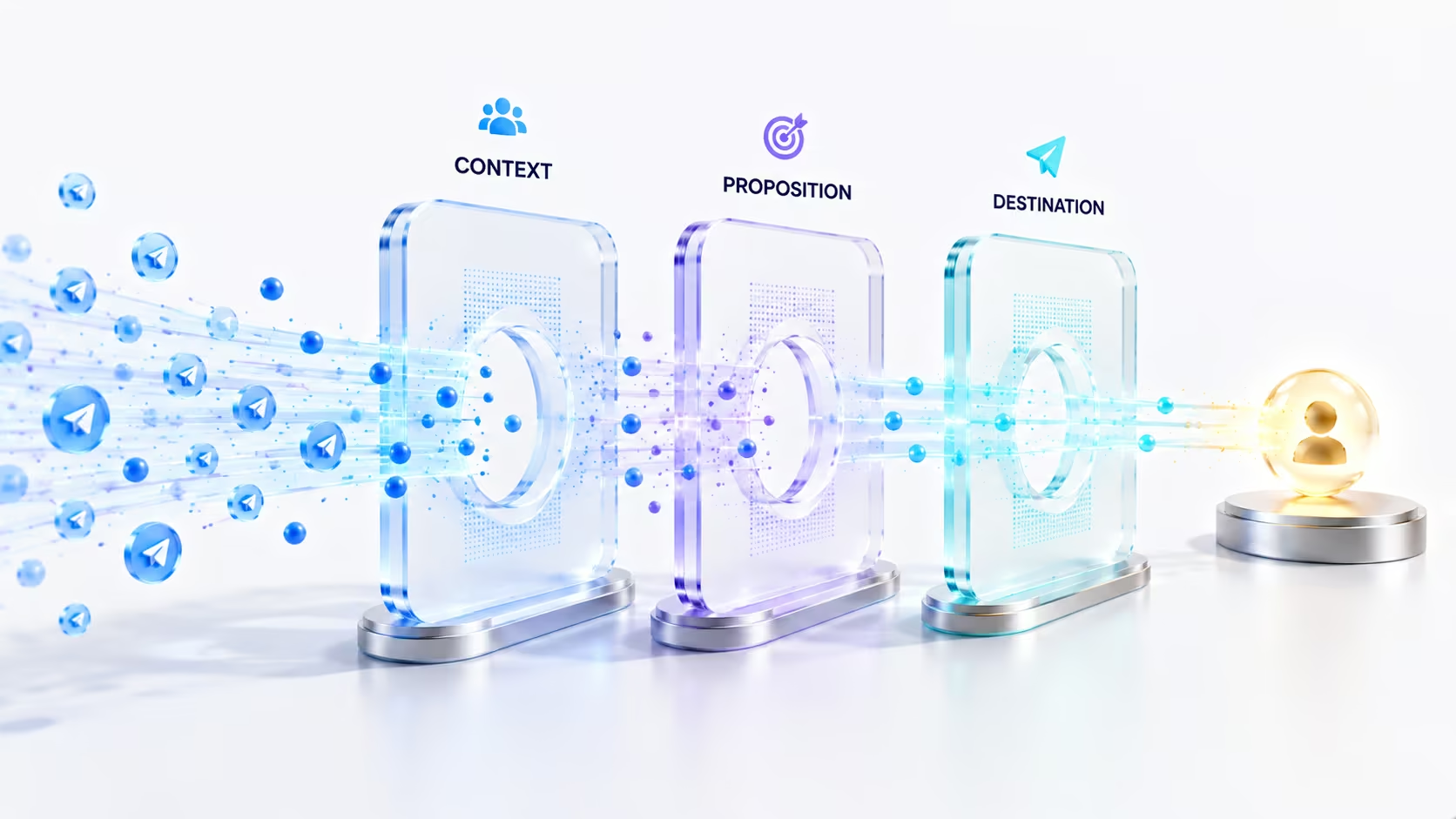
HDM uses a simple planning principle:
Targeting quality = audience context × proposition relevance × destination alignment
This is not an official Telegram formula. It is a practical framework for remembering that targeting quality is created by the whole experience, not only by the media setting.
How to Write Effective Telegram Ads
Telegram Sponsored Messages leave very little room for unnecessary copy.
Telegram’s advertising guidelines currently limit ad text to 160 characters, including spaces.
That means the message cannot carry an entire sales pitch.
A useful Sponsored Message normally has to do three things quickly:
- establish relevance;
- communicate value;
- give the user a clear next step.
The biggest mistake is trying to explain too much.
If the destination is a channel that publishes weekly market analysis, sell the usefulness of that analysis.
If the destination is a bot that helps users compare courses, explain that purpose.
If the business has several services, resist the temptation to squeeze all of them into one message.
One clear proposition is usually more useful than a compressed company brochure.
Example: Business Marketing
A weak version might say:
Grow your business today with our innovative solutions. We offer professional services and outstanding support. Join us now.
The problem is not grammar. The problem is that almost any agency could write it.
A more useful direction would be:
Running a growing UAE business? Get practical weekly guidance on paid media, analytics and acquisition. Explore the HDM channel.
Now the audience understands who the destination is for and what they are likely to receive.
Example: Professional Training
A generic message might say:
Looking for professional training? We offer great courses at competitive prices. Click now for more information.
A more useful alternative is:
Planning your next professional certification? Start the bot to compare programmes and find the right fit for your goals.
The second version starts with a real decision the user may already be making and gives the bot a clear purpose.
Example: Industry Intelligence
Compare:
The best market insights are here. Join our channel today and never miss an opportunity!
with:
Follow weekly analysis of UAE logistics trends, regulatory updates and operating costs. Join the channel for the latest briefings.
The second message is less promotional but more specific. The user understands what the destination provides before deciding whether it is relevant.

Telegram Ads Creative and Message Design
The classic Sponsored Message is primarily a message-led format.
That matters because advertisers sometimes approach Telegram as though they were building a Meta campaign and begin with the question:
What image or video should we create?
For the classic self-service Sponsored Message, the more important question is:
What can we communicate clearly in the limited space available?
The copy needs to fit the context in which it appears, communicate a useful proposition and accurately describe the next step.
The CTA should also be honest.
If the user is going to join a channel, make that clear.
If they are going to start a bot, make that clear.
There is usually little benefit in making the action sound more dramatic than it is.
The same principle applies to promotional claims.
Statements such as “guaranteed results”, “the number one solution” or artificial urgency do not make a weak proposition stronger. Telegram’s advertising policies also restrict misleading, exaggerated and deceptive claims.
With a short Sponsored Message, clarity usually creates more value than hype.
The HDM Telegram Ads Funnel
One of the easiest mistakes in Telegram Ads reporting is to stop measuring too early.
HDM uses the following planning framework:
Target → Message → Click → Join/Start → Engage → Qualify → Convert
This is not an official Telegram measurement model. It is a way to think about the full acquisition journey.
The first stages help explain whether the campaign is generating interest and acquisition.
The later stages determine whether that acquisition is useful.

Imagine two campaigns.
Campaign A acquires subscribers at a relatively low cost, but most of them rarely engage afterwards.
Campaign B costs more per subscriber, but those users continue consuming content and some become qualified enquiries.
If the business reports only subscriber acquisition, Campaign A appears stronger.
If it follows the entire journey, Campaign B may be the better investment.
That is why Telegram Ads should be evaluated as an acquisition system rather than an isolated media placement.
| Stage | Main question | Useful KPI |
| Target | Are we appearing in a relevant context? | Relevant delivery / targeted views |
| Message | Does the proposition make sense in that context? | Message response indicators where available |
| Click | Does the message create enough interest to continue? | Click or destination response where measurable |
| Join/Start | Do users continue into the promoted destination? | Channel joins / bot starts |
| Engage | Do acquired users continue interacting after arrival? | Content engagement / bot progression |
| Qualify | Are acquired users commercially relevant? | Qualified leads |
| Convert | Does the journey create measurable business value? | Sales, registrations or revenue |
Telegram Ads KPIs and Measurement
Telegram’s platform metrics and the business’s performance metrics should not be confused.
Platform reporting helps advertisers understand whether campaigns are delivering and whether people are entering the promoted Telegram destination.
But those metrics do not answer the most important commercial question:
Were those users valuable?
That requires downstream measurement.
For a channel-growth campaign, the business may want to know whether acquired subscribers continue consuming content.
For a bot-led campaign, it may want to know how many users progress far enough to become qualified prospects.
For a commercial campaign, the ultimate measures may include consultation requests, registrations, sales or revenue.
This is where metrics such as cost per subscriber or cost per bot start become more meaningful when paired with measures of user quality.
A campaign that produces inexpensive acquisition but no useful outcomes may be less valuable than a more expensive campaign that consistently generates qualified prospects.
A useful measurement hierarchy is:
| Measurement level | Examples | What it helps answer |
| Delivery | Views, CPM, spend | Is the campaign delivering? |
| Acquisition | Channel joins, bot starts | Are people entering the destination? |
| Engagement | Content consumption, bot progression | Do acquired users continue? |
| Qualification | Qualified enquiries or leads | Are the users commercially relevant? |
| Conversion | Sales, registrations, bookings | Does the journey create business outcomes? |
| Value | Revenue or repeat customer activity | Is Telegram creating sufficient commercial value? |
Tracking the Journey Beyond Telegram
The classic Sponsored Message uses a Telegram-native destination, but users may eventually move to a website.
That may happen when they register, make a booking, complete an application, check out or request a consultation.
When a website becomes part of the journey, UTM-tagged links can help distinguish traffic generated through paid Telegram activity from other Telegram referrals.
For longer sales cycles, CRM attribution can become even more useful.
Where the technical setup allows it, the business should try to preserve the original acquisition source as the user moves from Telegram into a lead record.
That does not mean every company needs an advanced integration before launching.
The important principle is:
Do not lose the original acquisition source once the user leaves Telegram.
If a Telegram-acquired user eventually becomes a qualified lead or customer, the business should have a reasonable method for connecting those events.

How to Optimize Telegram Ads
When performance is weak, the instinct is often to change the copy.
Sometimes that is correct.
Sometimes it is not.
A better optimization process starts by locating the weak stage.
If the campaign is delivering but users show little interest, look first at the relationship between the context and the message.
Are the selected environments actually relevant?
Does the proposition make sense there?
Is the copy specific enough?
If users respond to the ad but very few continue once they reach the destination, the problem may be in the channel or bot rather than the Sponsored Message.
Perhaps the channel does not immediately communicate its value.
Perhaps the bot is confusing.
Perhaps the ad promise and the destination do not match.
If users join but disappear quickly, acquisition quality or destination quality becomes the next question.
If users engage but rarely become qualified leads, the weak point may be the offer, qualification process or transition to a sales conversation.
A simple diagnostic view helps:
| What you see | What to investigate first |
| Strong delivery, weak response | Context and message relevance |
| Users respond but few join/start | Destination and expectation match |
| Joins but weak engagement | Destination value and onboarding |
| Bot starts but few qualified users | Qualification flow and offer |
| Good acquisition but poor conversion | Downstream sales journey |
| Strong lead quality but low volume | Potential scale opportunities |
The point is not to make optimization complicated.
It is to avoid changing the wrong thing.
A campaign may have strong copy and poor targeting. It may have relevant targeting and a weak destination. It may acquire high-quality users but lose them later in the sales process.
Until the weak stage is identified, optimization is mostly guesswork.
Common Telegram Advertising Mistakes
Many Telegram advertising mistakes are not really media-buying mistakes.
They are customer-journey mistakes.
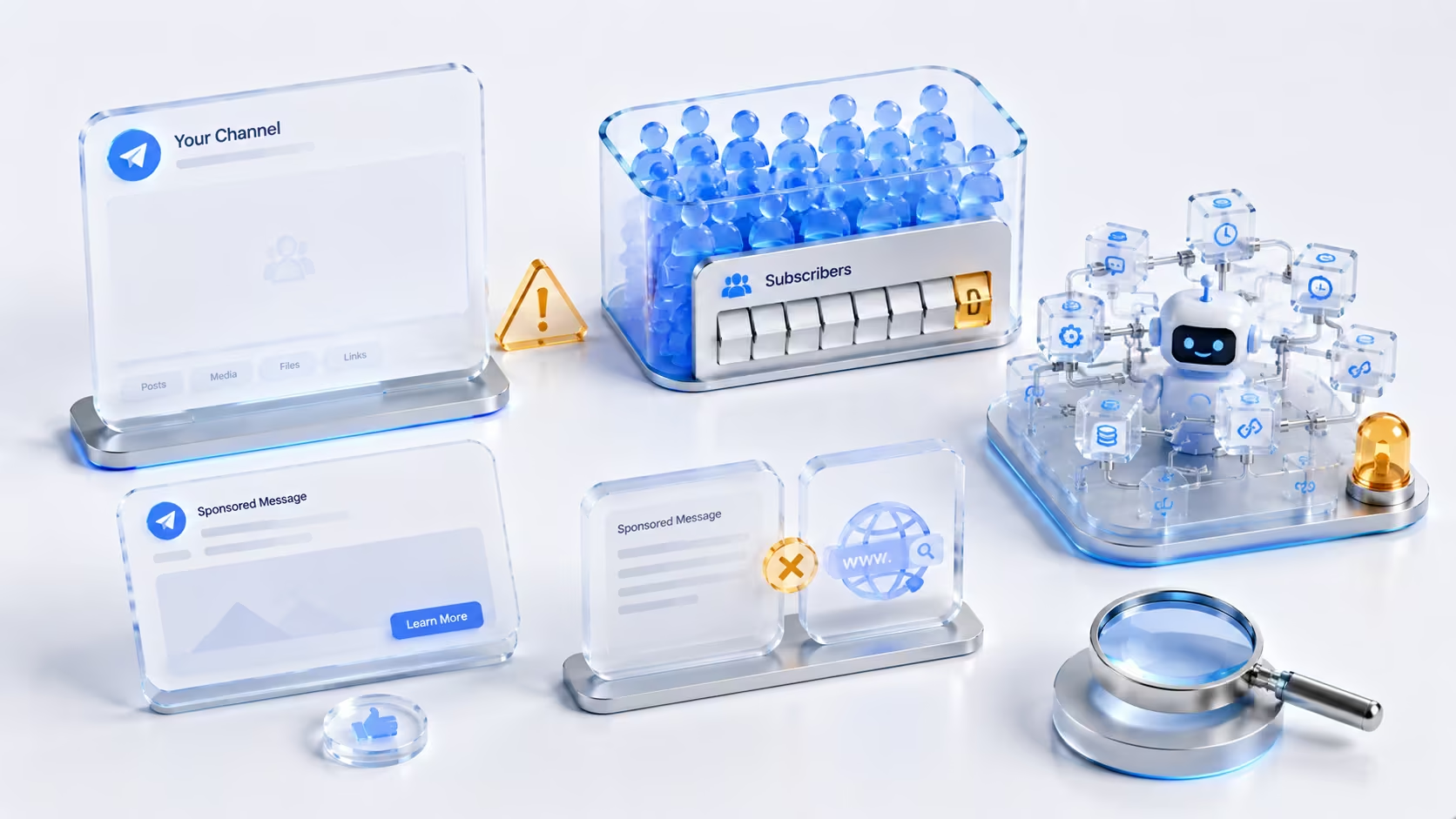
Launching Before the Destination Is Ready
A good Sponsored Message cannot compensate for an inactive channel, weak content or a confusing bot.
Paid acquisition should begin only when the destination gives first-time visitors a clear reason to continue.
Focusing Only on Subscriber Count
Subscriber acquisition is useful, but an inexpensive subscriber who never engages may have little commercial value.
Whenever possible, compare acquisition sources using downstream behaviour rather than member count alone.
Choosing Channels Superficially
A channel may look relevant because its title contains the right keyword, while its actual content and audience context tell a different story.
Evaluate the environment itself before deciding that it is a useful advertising context.
Using Generic Messages
Statements such as “discover our innovative services” tell the user almost nothing about why they should continue.
The ad should make sense specifically in the environment where it appears.
Creating a Message-to-Destination Mismatch
If the ad promises specialist insight and the destination contains mostly promotional company news, even relevant users may leave.
The value proposition needs to remain consistent from the Sponsored Message into the channel or bot.
Scaling Before Diagnosing
Increasing budget does not repair poor targeting, a weak destination, an unclear offer or a broken qualification journey.
It simply produces more of the same result.
Treating Artificial Member Growth as Acquisition
Buying low-quality or fake members may increase the visible size of a channel, but it does not create real demand, meaningful engagement or qualified prospects.
It also makes performance analysis less reliable.
Over-Automating the Journey
Bots can reduce friction, answer recurring questions and qualify users efficiently.
But a bot should not become an unnecessary obstacle between a high-value prospect and the person they actually need to speak with.
Automation works best when it removes unnecessary work.
Telegram Ads vs Meta Ads vs Google Ads
Telegram, Meta and Google solve different acquisition problems.
Telegram can be particularly useful when the business wants to bring users into a Telegram-native environment and continue the relationship there.
Meta is generally stronger for broad social discovery and visual demand generation.
Google Search is often strongest when users already know what they need and are actively looking for it.

| Channel | Particularly useful for | Main limitation |
| Telegram Ads | Telegram-native acquisition, channel growth, bot-led journeys | Requires a useful Telegram destination and post-click journey |
| Meta Ads | Visual discovery, social demand generation and retargeting | Users are often browsing rather than actively searching |
| Google Search Ads | Capturing explicit search demand | Depends on available search demand and competitive economics |
For some businesses, the platforms work together.
Meta may introduce a problem or category.
Google may capture people who are actively searching for a solution.
Telegram may help build a specialist audience or move prospects through a longer information journey.
The right mix depends on how customers actually behave.
Telegram Ads for UAE Businesses
For UAE businesses, it is tempting to justify Telegram with broad claims about platform usage in Dubai or the GCC.
That is not necessary.
The more useful question is whether the specific target audience uses Telegram in a meaningful way.
If relevant communities, channels or information environments exist, Telegram may deserve testing.
If they do not, adding a local keyword does not make the platform a good fit.
Language also matters in the UAE because customer journeys often cross English, Arabic and other language groups.

The Sponsored Message, channel or bot and eventual sales support should feel consistent for the user.
Telegram’s broader advertising documentation describes contextual signals including content language and approximate country or region in some advertising environments. Advertisers should still verify which targeting controls are available through the specific campaign interface or buying route they are using.
Telegram should also be considered alongside other acquisition channels rather than in isolation.
One customer may convert through:
Google Search → Website enquiry
Another may follow a longer path:
Telegram Sponsored Message → Specialist Channel → Bot → Sales Advisor
Both can be valid.
What matters is whether the business can identify where each journey contributes value.
Telegram Ads Example
Consider a Dubai-based specialist training company that wants to attract prospects for professional certification programmes.
This is an illustrative example rather than a client case study.
The company identifies Telegram environments where professionals already consume information about careers, qualifications and the relevant specialist field.
Instead of running a generic message about “high-quality training”, it uses a more specific proposition:
Planning your next professional certification? Start our Telegram bot to compare programmes and find the option that matches your goals.
The user starts the bot and selects their professional objective.
The bot presents relevant programme information and gives suitable users the option to speak with an advisor.
From there, the user may continue to a registration page or complete the sales process with human support.
The campaign should not be evaluated only on bot starts.
The business would want to know:
- how many users completed the relevant bot journey;
- how many became qualified enquiries;
- how many moved into conversations with an advisor;
- how many eventually registered.
That is the difference between measuring acquisition activity and measuring acquisition quality.
Are You Ready to Run Telegram Ads?
Before launching, a business should be able to answer seven basic questions with confidence:
- Is the target audience active in relevant Telegram environments?
- Is there a specific business outcome the campaign should support?
- Is the channel or bot useful before paid users arrive?
- Does the Sponsored Message accurately represent the destination?
- Is there a clear journey after the initial join or bot start?
- Can the business measure something more meaningful than acquisition volume?
- Is there a plan for diagnosing and improving weak performance?

HDM uses these seven questions as a simple Telegram Ads readiness check.
0–2 Yes: The campaign is probably not ready to scale. Fix the destination, objective or measurement gaps first.
3–5 Yes: A controlled test may be appropriate while the remaining weaknesses are addressed.
6–7 Yes: The campaign has a stronger foundation for structured testing and optimization.
This is an HDM planning tool, not an official Telegram scoring system.
Telegram Ads FAQs
What Are Telegram Ads?
Telegram Ads is Telegram’s official advertising platform. Its standard self-service product allows advertisers to place Sponsored Messages in eligible public Telegram channels and direct users to Telegram-native destinations such as channels or bots.
How Do Telegram Ads Work?
Advertisers create a Sponsored Message, choose eligible placements, set a CPM and campaign budget, submit the ad for review and monitor its performance. In the documented standard self-service workflow, advertisers can select eligible public channels and promote a Telegram channel or bot.
Where Do Telegram Ads Appear?
Telegram’s standard self-service documentation describes Sponsored Messages in public one-to-many channels with at least 1,000 subscribers.
Telegram’s broader privacy documentation also describes advertising in bots, Stories and public search. These environments should not automatically be assumed to use the same buying or targeting rules as the classic channel-based self-service product.
Can Telegram Ads Link Directly to a Website?
In the standard self-service Sponsored Message workflow, links must lead to a Telegram channel or bot rather than a conventional external website URL.
Users can later move from that Telegram destination to a website if it is part of the customer journey.
How Much Do Telegram Ads Cost?
Telegram Ads uses a CPM model, meaning advertising cost is based on 1,000 views.
Minimums, funding methods and other platform requirements can change, so businesses should verify the current terms inside Telegram’s official advertising platform before setting a campaign budget.
How Do You Target Audiences on Telegram Ads?
The documented self-service workflow allows advertisers to select specific eligible public channels where Sponsored Messages should appear.
Telegram’s broader advertising system also uses additional contextual factors in some environments. Advertisers should verify which controls are available through the campaign setup they are actually using rather than assuming every placement works identically.
Are Telegram Ads Good for Small Businesses?
They can be, particularly when the target audience already uses Telegram and the business has a useful channel or bot.
If the only objective is immediate website enquiries, another paid channel may offer a more direct route.
How Do You Measure Telegram Ads Performance?
Start with platform-level delivery and acquisition measures.
Then evaluate what happens after users enter the channel or bot: engagement, qualification, leads, sales and revenue where those outcomes can be measured reliably.
Are Telegram Ads Better Than Meta Ads?
Not universally.
Telegram can be useful for Telegram-native communities, channels and bot-led journeys, while Meta offers a broader social and visual advertising ecosystem.
The better choice depends on the audience, destination, campaign objective and customer journey.
What Is a Sponsored Message on Telegram?
A Sponsored Message is an official Telegram advertising placement.
Telegram’s current advertising guidelines limit ad text to 160 characters, including spaces.
Treat Telegram Ads as the Beginning of the Journey
The most useful way to approach Telegram Ads is to stop thinking of the Sponsored Message as the entire campaign.
It is only the first step.
The real system is:
Relevant context → relevant message → useful destination → engagement → qualification → business outcome
When those stages work together, Telegram can become a useful part of the acquisition mix.
When they do not, buying more impressions or acquiring more subscribers usually does not solve the underlying problem.
For businesses evaluating Telegram alongside Google Ads, Meta Ads and other acquisition channels, our digital agency can help determine where Telegram belongs in the customer journey and how performance should be measured before campaign budgets are scaled.
Discuss Your Paid Media Strategy