
Google applies broad and significant changes to its algorithms and search systems several times a year. These changes are known as Core Updates. Whenever such updates are released, Google announces them on its official Google Search Ranking Updates list.
Generally, most websites do not need to worry about Core Updates and may not even notice when they are released. However, if you have experienced changes in your website’s traffic and these changes coincide with a Core Update, this article can serve as a helpful guide. In this blog, we explain how Core Updates work and, if necessary, what actions you can take to evaluate and improve your content.
How Do Core Updates Work?
The purpose of Core Updates is to help Google better fulfill its primary mission: providing useful and reliable results to users. These updates are broad in nature and do not target any specific website or individual page directly.
As web content continuously evolves, Google regularly reassesses and updates its systems as a whole in order to keep pace with these changes.

A Simple Example to Better Understand Core Updates
Imagine a friend asks you to recommend your top 20 favorite restaurants. You share a list that you created in 2019. However, the issue is that since then, new restaurants have opened, and your experiences with some existing restaurants may have improved or declined. As a result, your list changes: some restaurants move up in ranking, while others move down.
It is important to note that the restaurants that move down are not necessarily “bad”; rather, there are simply better options available today to include in the list. Google’s Core Updates work in the same way.
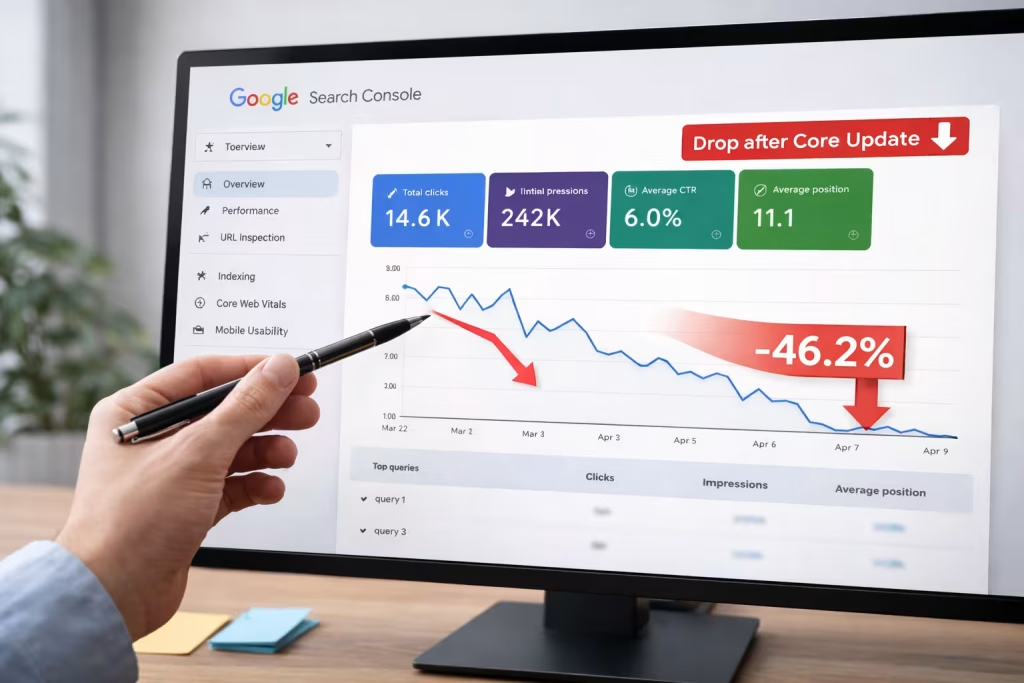
Analyzing Traffic Drops in Search Console
If you notice a drop in rankings or traffic and believe it may be related to a Core Update, Search Console can help you determine whether changes are needed. The review process includes the following steps:
1. Make sure the Core Update has fully rolled out
Carefully check the start and end dates of the update through the Search Status Dashboard to ensure that the Core Update has been completed.
2. Choose the appropriate comparison timeframe
It is recommended to wait at least one week after the Core Update has fully finished before reviewing your site’s data in Search Console. After this one week, compare your site’s performance during this timeframe with the week before the start of the update to more accurately identify any changes.
3. Review your top pages and queries
Analyze your site’s main pages and queries and compare their positions before and after the Core Update. At this stage, it is important to determine the extent of the ranking drop.
If the decrease is minor—for example, a drop from position 2 to position 4—serious actions are usually not necessary, and it is often recommended to avoid making changes to content that is still performing well.
However, if the ranking drop is significant—such as falling from position 4 to position 29—a more detailed and in-depth evaluation of page performance is required.
Evaluating Severe Ranking Drops
If your website experiences a significant and ongoing overall decline, Google recommends reviewing the entire site (not just a few specific pages) to determine whether your content is useful, trustworthy, and people-first.
Key Recommendations:
- Review your website with a completely objective perspective.
- Ask trusted individuals who are not involved with your site to conduct this evaluation.
- Carefully analyze the pages that have experienced the largest drops.
- Check whether other pages on the web provide better answers to user needs.
Important Considerations When Making Changes
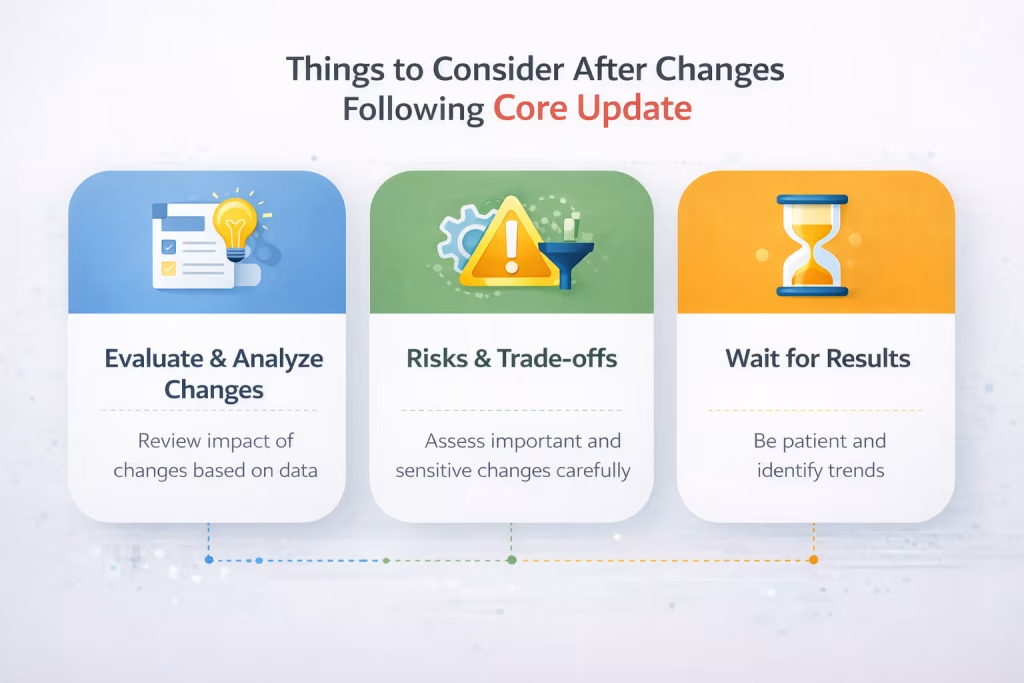
When implementing changes on your website, avoid making quick, short-term fixes based solely on hearsay or unverified recommendations. For example, do not remove a section of a page simply because it has been said that it is not SEO-friendly. Instead, focus on changes that are logical, understandable for users, and sustainable in the long term.
You should also consider how content can be meaningfully improved. In some cases, rewriting or restructuring content can make it more readable for users and create a clearer, more intuitive navigation path within the page.
Content removal should be considered a last resort and only carried out when you are certain that the content cannot be improved or corrected. In fact, if you are considering removing entire sections of your website, this may indicate that those sections were originally written more for search engines than for users. In such cases, removing unhelpful content can contribute to improved performance of your high-quality content.
How Long Does It Take to See the Impact of Changes in Search Results?
If you have taken steps to improve your website’s performance, it may take some time for the effects to appear in search results. Some changes may have an impact within a few days, but in many cases, several months are required for Google’s systems to recognize and confirm that your website is consistently producing useful, reliable, and user-focused content in the long term.
If, after several months, you still do not see changes in the results, you may need to wait until the next Core Update is released.
However, it is not always necessary to wait for a major Core Update to see the impact of improvements. Google continuously makes changes and updates to its search algorithms, including smaller core updates. These updates are typically not publicly announced because they do not have a broad or significant impact, but they can still lead to ranking improvements when content quality improves.
Conclusion
Google Core Updates are an integral part of the ongoing process of improving search algorithms, with the primary goal of enhancing the quality of results for users. When dealing with these updates, the most important actions are to avoid hasty decisions, focus on the overall quality of the website, produce useful and user-focused content, and analyze data with a realistic perspective.
If you have experienced a drop in rankings or traffic after a Core Update and need a professional review of your website’s status, you can contact us for a free SEO consultation at +971 56 260 1368.