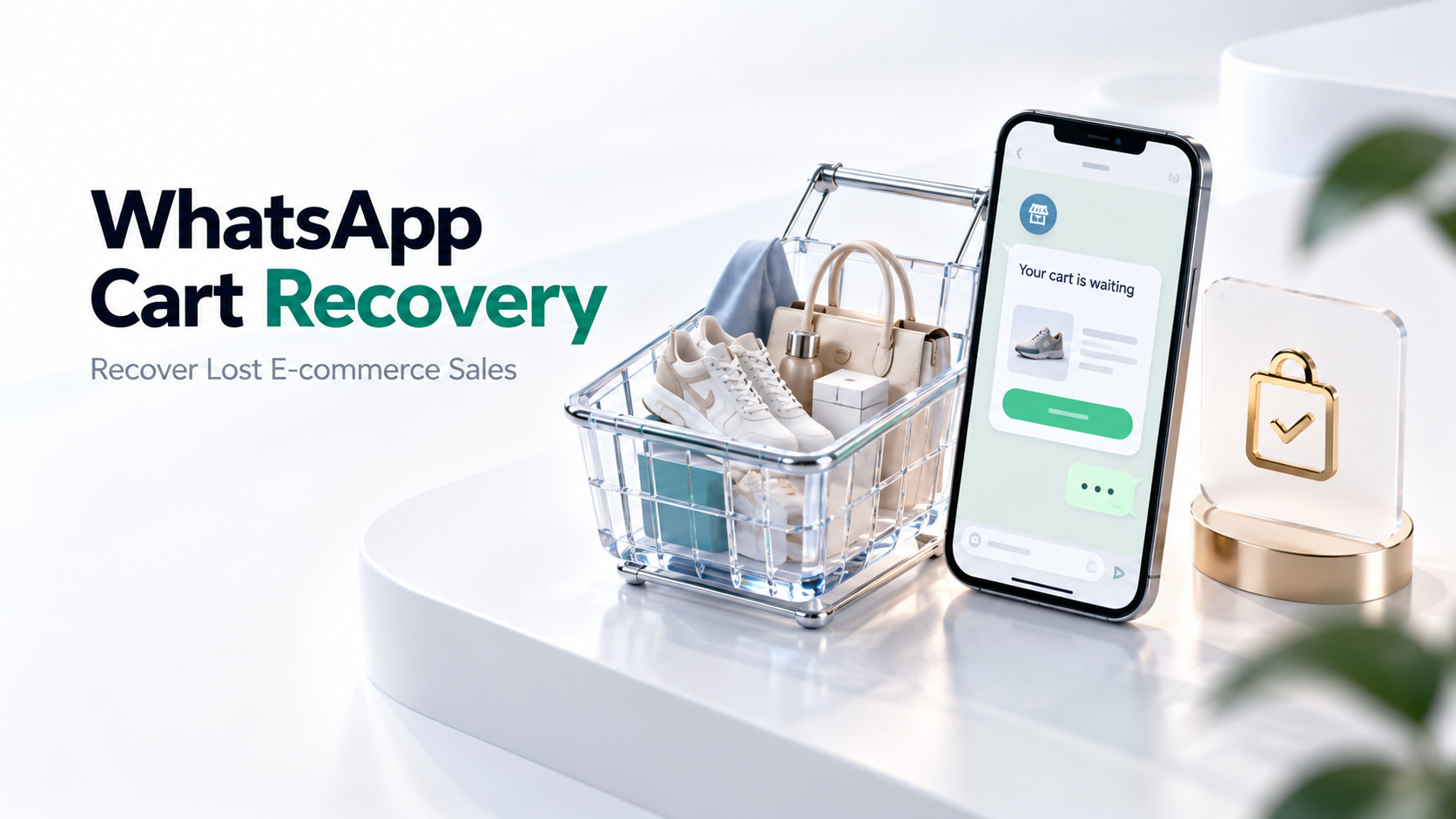
WhatsApp cart recovery is an automated sequence of WhatsApp messages sent to shoppers who added items to a cart and left without buying. For UAE e-commerce brands, the stats show WhatsApp recovery to be effective for around 15–25% of abandoned carts, compared with 3–10% for email alone. An important local fact is that WhatsApp reaches about 90% of UAE consumers, making the channel perfect for mobile-first stores. Setup needs explicit opt-in, an approved Meta message template, and a lawful basis under the UAE PDPL.
But what does it really look like to use WhatsApp for your ecommerce shop? Imagine a customer in Dubai sees your Instagram ad, visits your store, adds a pair of shoes to the cart, and reaches checkout. Suddenly a phone call comes in, a delivery arrives, or the customer simply decides to think about the purchase some more.
The cart is still there, but the sale is gone.
For an established e-commerce business, hundreds or thousands of these abandoned carts can mean a substantial amount of missed revenue. The United Arab Emirates e-commerce market is estimated to be $12.30 billion in 2026, and Mordor Intelligence predicts it will rise to $21.01 billion by 2031.
WhatsApp cart abandonment recovery gives businesses a practical and easy way to follow up while the buyer’s purchase intent is still fresh.
This guide will walk you through the mechanism, the recommended message sequence, and the UAE compliance rules you need to understand before using WhatsApp cart recovery.
Why do UAE e-commerce brands lose more revenue to cart abandonment than they think?
UAE e-commerce brands lose more revenue to cart abandonment than most global counterparts, because mobile shopping is dominant in the UAE and mobile carts generally have higher abandonment than desktop carts.
According to Baymard Institute’s latest published research, the global average online shopping cart abandonment rate is 70.22%. The stats come from 50 different studies. Baymard also notes that mobile abandonment is usually higher than desktop abandonment.
For a UAE store, the mobile issue matters because smartphones account for the majority of online transactions. Mordor Intelligence reports that smartphones make up 78.67% of UAE e-commerce transaction volume in 2025.
Unlike what many believe, the problem is not that customers change their minds. Baymard Institute’s research identifies several causes, like unexpected additional costs, complicated checkout processes, account creation requirements, and shoppers who are simply looking around and not ready to purchase.
The difference is very important for recovery. A WhatsApp message cannot magically convince every shopper to buy. A reminder is useful when the customer already wanted the product but was distracted, needed reassurance, came across friction, or postponed the decision.
The UAE market also gives WhatsApp a particularly strong position. The Mobile Ecosystem Forum’s 2025 Yearbook reported WhatsApp usage at 90% among its UAE messaging-channel data, with Instagram at 65% and Facebook Messenger at 50%.
For a business owner, the takeaway is a no-brainer: if most of your customers shop on phones and a large proportion of UAE consumers use WhatsApp, recovering abandoned carts through the same mobile channel can be the logical strategy.

Why does WhatsApp recover more abandoned carts than email in the UAE?
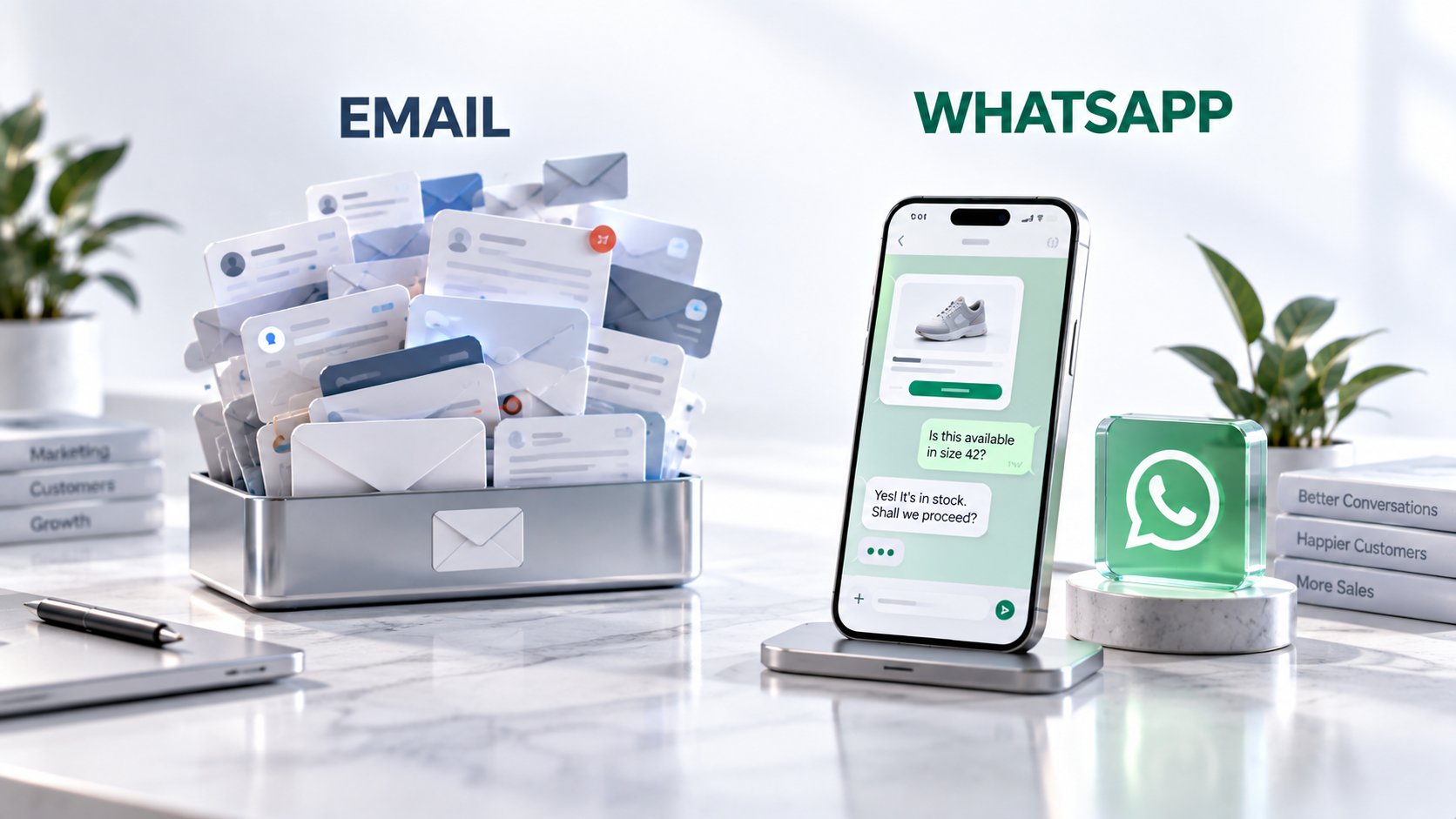
WhatsApp can outperform email for abandoned-cart recovery because WhatsApp places the reminder inside a highly used conversational channel, while email competes with a crowded inbox.
The stats will tell you all you need to know: 95–98% message-read/open performance for WhatsApp versus roughly 39–50% for email, with WhatsApp click-through rates commonly reported around 20–40% versus 6–8% for email.
| Channel | Typical open/read benchmark | Typical CTR benchmark | Practical recovery benchmark |
| ~39–50% | ~6–8% | ~3–10% | |
| ~95–98% | ~20–40% | ~15–25% |
Industry case studies and vendor datasets commonly report 15–25% WhatsApp abandoned-cart recovery, while email-only recovery is often reported as low as 3–10%. Results vary significantly according to average order value, customer intent, opt-in quality, message quality, product category, and how recovery is attributed.
The huge gap is not only due to a high read rate. WhatsApp is conversational. A customer can reply with a question like, “Does this come in medium?” or “How long is delivery to Abu Dhabi?” and get the help needed without opening another communication channel.
For UAE stores, that conversational factor can be especially useful when customers hesitate because of delivery, returns, sizing, payment, or product questions.
How do you build a WhatsApp cart recovery flow?
A WhatsApp cart recovery flow has four components: a compliant opt-in point, a connected WhatsApp Business Platform account, an approved message template, and a timed three-message sequence.
How do you collect a compliant WhatsApp opt-in?
A compliant WhatsApp opt-in is clear, affirmative consent captured at checkout or another appropriate customer touchpoint that tells the customer WhatsApp will be used for the stated communication purpose.
A practical UAE e-commerce setup can obtain consent at:
- Checkout: Add a separate, unchecked WhatsApp consent box beside the customer’s phone number.
- Account creation: Allow customers to opt into WhatsApp communications when creating an account.
- Click-to-WhatsApp advertising: Capture the conversation after the customer deliberately starts a WhatsApp interaction.
- Post-purchase or lead forms: Give customers a clear choice to get future WhatsApp communications.
Federal Decree-Law No. 45 of 2021, the UAE Personal Data Protection Law (PDPL), generally prohibits processing personal data without consent except for specified lawful exceptions. Article 6 requires consent to be clear, simple, unambiguous, and easily accessible, and requires businesses relying on consent to be able to demonstrate that consent. Customers can also withdraw consent.
A pre-checked box is therefore a poor compliance design. A better example is:
“Yes, I’d like to receive order updates and relevant offers from [Brand] on WhatsApp.”
Keep marketing consent separate from essential order communications so customers can understand exactly what they are agreeing to.
What is the right three-message sequence and timing?
The standard WhatsApp cart recovery sequence is three messages sent at around 1 hour, 24 hours, and 48–72 hours after abandonment.
| Message | Timing | Job | Expected share of recovered revenue |
| Message 1 | ~1 hour | Remind the customer | Highest |
| Message 2 | ~24 hours | Remove hesitation and build trust | Medium |
| Message 3 | ~48–72 hours | Provide final motivation | Lower but incremental |
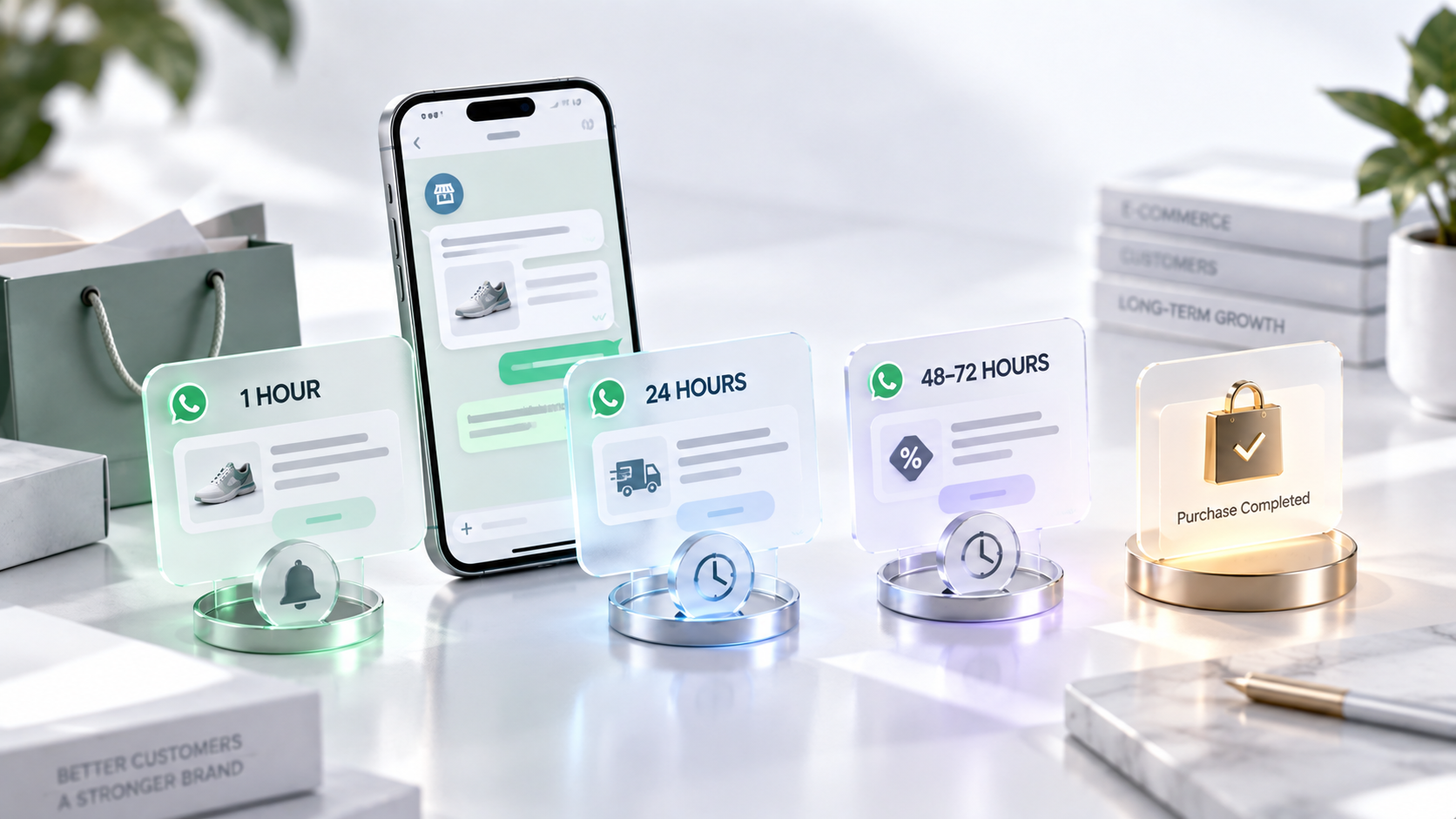
The first message is meant to be helpful rather than aggressive. A customer who got distracted does not need a discount; the customer simply needs a quick path back to the saved cart.
The second message can address common objections through reviews, product information, delivery details, or customer support.
The third message can introduce a small incentive, such as free delivery or a limited discount, where the economics make sense.
The sequence should automatically stop when the customer purchases or opts out. Continuing to send recovery messages after a completed purchase creates an unnecessary customer-experience problem.
How should Arabic and English personalization work?
Language selection for WhatsApp cart recovery should follow the language the shopper used on the website or chose during checkout, rather than assuming language based on the phone number’s country code.
For a UAE store, maintain a language attribute such as:
- English
- Arabic
- Bilingual
- Customer-selected preference
Do not translate every message literally. Arabic copy should sound natural to Arabic-speaking customers, while English copy should remain concise and conversational.
Personalization should also use information the customer actually provided, such as:
- {{first_name}}
- {{product_name}}
- Product category
- Cart value
- Preferred language
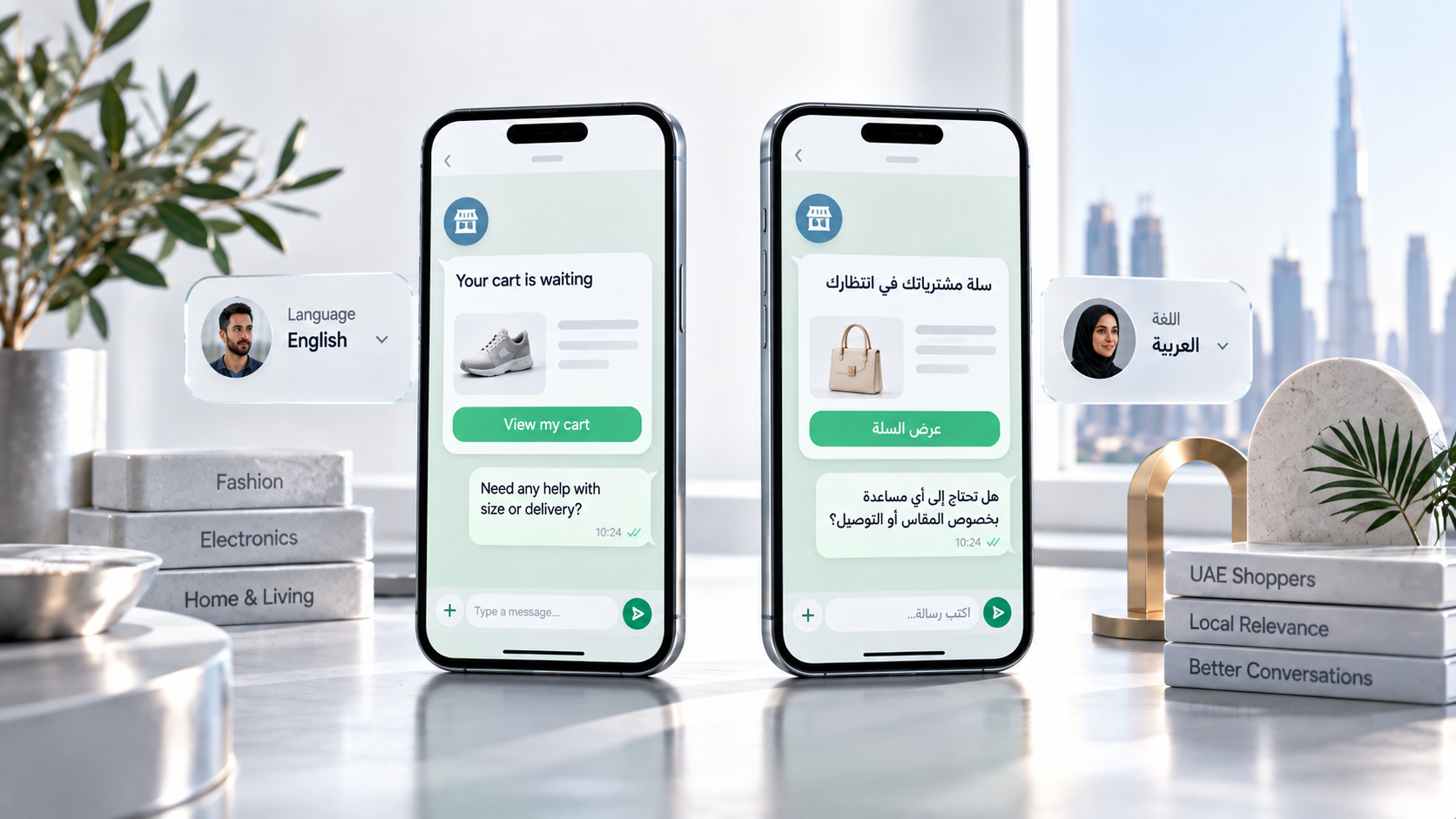
Avoid excessive personalization. A message that feels like a human reminder is generally more appropriate than one that looks like a database export.
A useful technical foundation is the WhatsApp Business Platform (Cloud API). Businesses can connect the WhatsApp Business Platform directly or use a business solution provider (BSP). Common BSP options include Interakt, Wati, and Infobip, with differences in automation, integrations, support, and pricing.
| BSP | Differentiator to evaluate |
| Interakt | E-commerce and customer-engagement workflows |
| Wati | No-code automation and team inbox features |
| Infobip | Broader enterprise communications infrastructure |
High-converting WhatsApp cart recovery Message Templates
A high-converting WhatsApp cart recovery message names the abandoned product, stays concise, and suggests one clear action.
Template 1 — Reminder
Timing: Sent 1 hour after abandonment
English:
“Hi {{first_name}}, you left {{product_name}} in your cart. We’ve saved it for you. Ready to complete your order?”
Arabic:
“مرحباً {{first_name}}، تركت {{product_name}} في سلة التسوق. ما زلنا نحتفظ به لك. هل ترغب في إكمال طلبك؟”
Why it works: The first message functions as a reminder to the customer. It highlights the unfinished action without reducing the product’s price.
Template 2 — Trust and social proof
Timing: Sent 24 hours after abandonment
English:
“Still considering {{product_name}}, {{first_name}}? Customers love its quality and fit. Your cart is still waiting if you’d like to complete your order.”
Arabic:
“ما زلت تفكر في {{product_name}} يا {{first_name}}؟ يحبه عملاؤنا لجودته وملاءمته. سلتك ما زالت محفوظة إذا أردت إكمال الطلب.”
Why it works: The message addresses hesitation by adding reassurance rather than immediately offering a discount.
Template 3 — Incentive
Timing: Sent 48–72 hours after abandonment
English:
“{{first_name}}, your {{product_name}} is still in your cart. Use code WELCOME10 for 10% off your order today.”
Arabic:
“{{first_name}}، ما زال {{product_name}} في سلة التسوق. استخدم الرمز WELCOME10 للحصول على خصم 10% على طلبك اليوم.”
Why it works: The final message gives price-sensitive shoppers an additional motive to complete the purchase.
Discounts should not become automatic. If customers find out that abandoning a cart produces a coupon, some customers may deliberately abandon carts to wait for the discount.
It is also absolutely important to remember that any UAE store should keep the message within the approved template rules applicable to WhatsApp Business Platform messaging. A message template is a pre-approved WhatsApp message format that Meta reviews before a business can send certain business-initiated messages outside the customer service window.
Is WhatsApp marketing legal in the UAE?
WhatsApp marketing is legal in the UAE when the business has an appropriate lawful basis, obtains the required consent for direct marketing, follows applicable Meta policies, and provides a practical way for customers to stop marketing communications.
Federal Decree-Law No. 45 of 2021 (PDPL) gives individuals the right to object to processing for direct marketing, including profiling related to direct marketing. The UAE government’s summary of the law also states that personal-data processing generally requires consent except in specified circumstances.
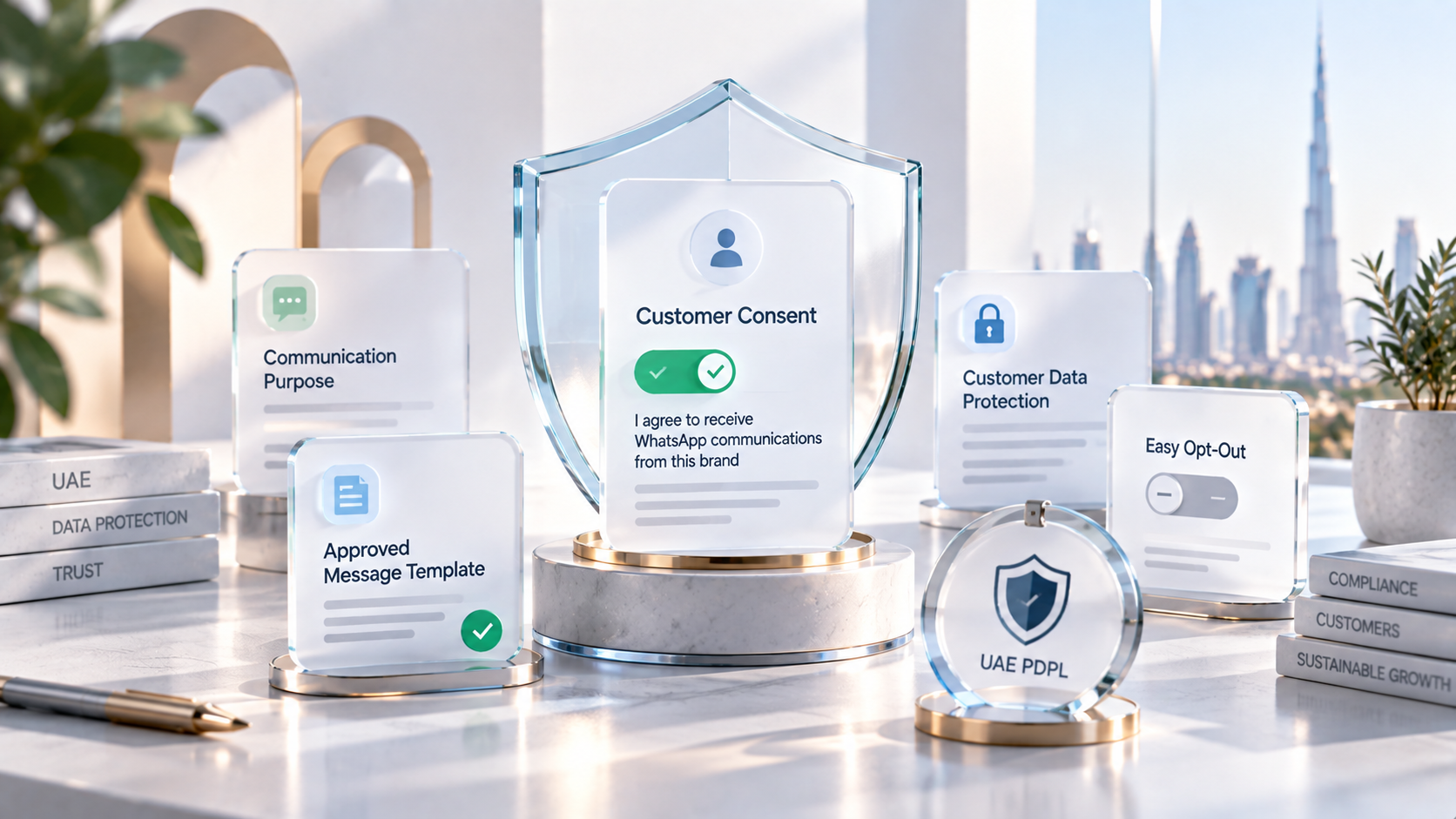
For a WhatsApp cart recovery program, a practical compliance checklist is:
- Obtain clear WhatsApp consent before sending marketing reminders.
- Keep evidence of when and how consent was obtained.
- Explain the purpose of the WhatsApp communication.
- Do not assume email consent automatically equals WhatsApp consent.
- Make withdrawal of consent straightforward.
- Stop the automated sequence after an opt-out.
- Use approved WhatsApp message templates where required.
- Protect customer data and limit collection to what the recovery workflow needs.
- Review cross-border data-processing arrangements with your providers.
The UAE PDPL also contains rules concerning international transfers of personal data, so businesses using overseas SaaS platforms, BSPs, analytics systems, or cloud infrastructure should review their data-processing arrangements instead of assuming the location of the store determines every data-flow obligation.
The compliance position can differ for businesses operating in special financial free zones such as the DIFC or ADGM, which have their own data-protection regimes. The UAE federal PDPL should therefore not be treated as a substitute for zone-specific legal advice.
How much does WhatsApp cart recovery cost to set up?
WhatsApp cart recovery has three main cost lines: Meta’s per-message charge, the BSP or software subscription, and the one-time setup and integration work.
As of September 2026, published rate-card data for the UAE puts Meta’s marketing-message rate at approximately $0.05 per delivered message, with some published July/September rate-card reproductions showing approximately AED 0.18 per marketing message. Pricing can change, so businesses should verify the live Meta rate card before budgeting.
| Cost | Typical consideration |
| Meta messaging | About $0.05 / AED 0.18 per UAE marketing message at the September 2026 rate |
| BSP/software | Usually a monthly subscription, depending on provider and features |
| Setup/integration | One-time cost depending on Shopify, Salla, Magento, CRM, and automation complexity |
For example, sending 10,000 marketing-template messages at roughly AED 0.1832 each would produce about AED 1,832 in Meta messaging charges, before any BSP subscription, integration, taxes, or other service costs.
Meta’s pricing model is changing as well. Current 2026 documentation and rate-card reproductions distinguish marketing, utility, authentication, and service messaging, so older articles describing WhatsApp primarily in terms of “conversation charges” may no longer show the current pricing structure.
For a UAE store, the sensible thing to do is to calculate cost per recovered order rather than focusing only on the cost per message.
How do you measure WhatsApp cart recovery performance?
Four metrics matter for WhatsApp cart recovery: opt-in rate, message-to-click rate, recovery rate, and recovered revenue per message sent.
Monitor the funnel separately so a high message-read rate does not disguise weak conversion.
Recovery rate = Recovered abandoned carts ÷ Total eligible abandoned carts × 100
For example, if 1,000 eligible carts are abandoned and 180 subsequently purchase after receiving the recovery flow, the attributed recovery rate is 18%.
The four core metrics are:
- Opt-in rate: Percentage of eligible customers who agree to receive WhatsApp messages.
- Message-to-click rate: Percentage of delivered messages that produce a cart or checkout click.
- Recovery rate: Percentage of eligible abandoned carts that result in an attributed purchase.
- Recovered revenue per message: Total attributed recovered revenue divided by messages sent.
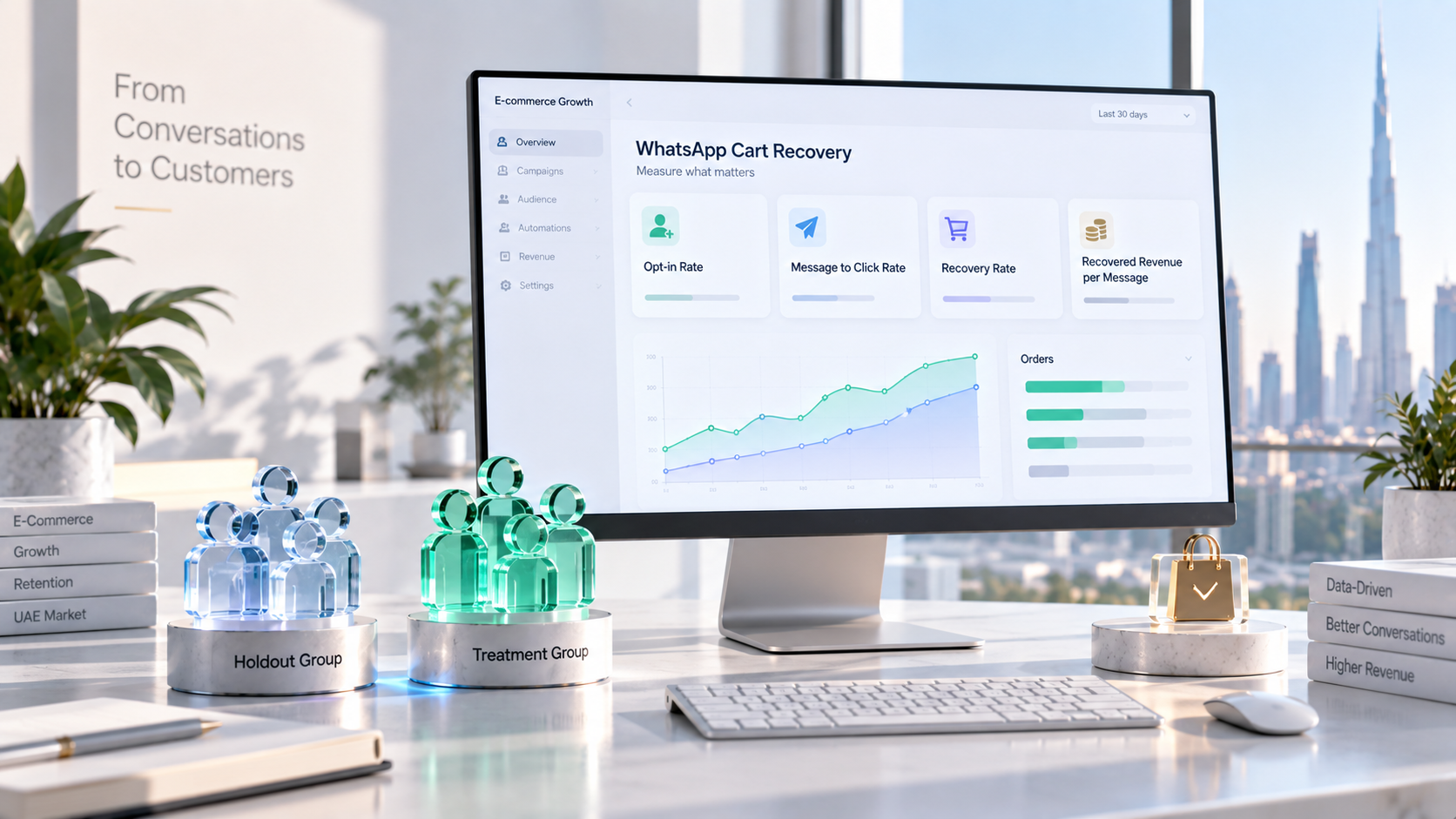
Do not treat attributed recovery as automatically incremental revenue. Some customers would have returned and purchased without receiving a WhatsApp message.
For a stronger measurement system, run a small holdout group that does not receive the WhatsApp recovery flow and compare its purchase rate with the treatment group. The difference gives a more realistic estimate of incremental recovery.
Conclusion: Is WhatsApp cart recovery worth adding to a UAE store?
For a UAE e-commerce business with meaningful mobile traffic, WhatsApp cart recovery certainly deserves a shot, mainly because WhatsApp is the dominant form of communication on phones in the UAE.
The opportunity is not simply “send more WhatsApp messages.” A profitable system starts with legitimate opt-in, uses the WhatsApp Business Platform correctly, sends a small number of well-timed messages, adapts English and Arabic communication to customer preference, and measures incremental revenue rather than vanity metrics.
Baymard Institute’s current research puts average global cart abandonment at about 70.22%, meaning the problem is large before a store even considers WhatsApp.
For UAE businesses, the strongest approach is to treat WhatsApp as one part of a broader conversion system: improve checkout friction first, then use WhatsApp to recover shoppers who still leave.
Frequently asked questions
Is WhatsApp marketing legal in the UAE?
Yes, when the business has a lawful basis and satisfies applicable consent and marketing requirements. Federal Decree-Law No. 45 of 2021 (PDPL) generally requires consent for personal-data processing and gives individuals a right to object to direct marketing. Meta also requires businesses to follow its WhatsApp Business Platform policies, including applicable opt-in requirements. All customers should have easy access to withdraw marketing consent.
How much does WhatsApp cart recovery cost to set up in the UAE?
About AED 0.18 per marketing message at the September 2026 Meta rate, plus any BSP subscription and setup or integration costs. A business sending 10,000 marketing messages would therefore face around AED 1,832 in Meta message charges at that rate, before additional costs. Meta pricing changes, so the live rate card must be checked before launch.
What recovery rate should a UAE store expect from WhatsApp?
15–25% of abandoned carts is a reasonable upper benchmark for a well-designed WhatsApp recovery program, not a guaranteed UAE average. Recovery varies according to the quality and size of the opt-in base, average order value, customer intent, message timing, and message quality. Results above 25% should be treated cautiously unless supported by transparent, relevant first-party data.
How many WhatsApp cart recovery messages should you send?
Three. A practical sequence is one message approximately 1 hour after abandonment, a second after about 24 hours, and a final message after 48–72 hours. The sequence should stop immediately after purchase or opt-out. Sending substantially more messages can turn a helpful reminder into unwanted marketing.
Do you need a customer’s consent before sending a WhatsApp cart reminder?
Yes. Email consent should not be assumed to transfer to WhatsApp marketing. Federal Decree-Law No. 45 of 2021 requires consent to meet specific standards when consent is the lawful basis, including being clear, simple, unambiguous, and easily accessible. Consent must also be withdrawable.
Can WhatsApp cart recovery work with Shopify, Salla and Magento?
Yes. Shopify stores can generally connect through WhatsApp-focused applications or third-party automation, while Salla and Magento stores can connect through available BSP integrations, APIs, webhooks, or middleware. The exact implementation depends on the store’s checkout architecture and the WhatsApp Business Platform provider selected.