
If you’ve ever searched for a service online and noticed a few businesses appearing before the regular search results, you’ve already seen Google Ads at work. A homeowner looking for an emergency plumber, a marketing manager searching for CRM software, or someone trying to find a dentist nearby—in many cases, the first businesses they see are not necessarily the ones with the strongest organic SEO. Instead, they are businesses strategically using Google Ads to place themselves in front of potential customers at the exact moment those customers are actively searching.
This ability to appear precisely when demand already exists is one of the main reasons Google Ads has become the backbone of modern digital marketing. According to industry data, Google commands over 80% of the global search engine market share, making its advertising network the most widely used platform in the world.
But despite its popularity, many business owners still misunderstand what Google Ads actually does. Some assume it’s simply a way to buy top rankings on Google overnight, while others expect instant sales as soon as a campaign goes live. Both assumptions usually lead to disappointment. Google Ads is neither a shortcut to business growth nor a replacement for a solid marketing strategy. It’s a platform designed to connect businesses with people who are actively looking for products, services, or information. Understanding how it works is the first step toward deciding whether it’s the right channel for your business growth.
Understanding the Core of Google Ads
Google Ads is Google’s online advertising platform that allows businesses to promote their products and services across its vast digital ecosystem. Depending on your goals and campaign types, advertisements can appear in Google Search results, YouTube videos, Google Maps, Gmail inboxes, mobile applications, and millions of partner websites that participate in the Google Display Network.
The platform operates primarily on a pay-per-click model, commonly known as PPC advertising. In simple terms, advertisers do not pay just to display their ad; they usually pay only when a user actively clicks on their advertisement.
What truly differentiates Google Ads from traditional advertising channels is intent. A billboard reaches everyone who drives past it, and a radio ad reaches everyone listening to a particular station, regardless of their current needs. Google Ads, however, reaches people who are already actively seeking something related to your business. This difference changes everything. Instead of interrupting people with disruptive advertising, businesses can place their solutions right in front of users who are already looking for them.
Why Google Ads Became So Popular
Before digital advertising became mainstream, businesses often had limited visibility into their marketing performance. A company could invest thousands of dollars in newspaper ads, magazine placements, or radio campaigns without ever knowing exactly how many customers those advertisements actually generated.
Google Ads fundamentally changed that landscape. For the first time, businesses gained the ability to track performance metrics in real time, including:
- How many people viewed an ad (Impressions)
- How many clicked on it (Clicks)
- How many completed a desired action (Conversions)
- Exactly how much each customer cost to acquire (CPA)
This level of precise measurement helped transform marketing from a largely assumption-based activity into a highly predictable, data-driven process. Today, companies of all sizes utilize Google Ads to scale their operations. Local businesses use it to generate phone calls, professional service firms use it to attract qualified leads, e-commerce brands use it to increase online sales, and software companies use it to acquire free trial users. While the final objectives differ across industries, the underlying principle remains identical: reaching people when they are actively looking for a solution.
🔗 Analyze the acquisition economics: Explore the precise budget dynamics and bidding frameworks we mapped out in our strategic guide on the actual google ads cost in dubai.
The Core Vocabulary: Google Ads Glossary
To effectively navigate the platform, you must understand the core metrics that dictate your campaign performance and budget efficiency. These metrics form the foundation of all paid acquisition strategies:
- CPC (Cost Per Click): The actual amount you pay each time a user clicks on your ad. This is dynamic and heavily influenced by competition and ad relevance.
- CTR (Click-Through Rate): The percentage of people who click your ad after seeing it
Calculation: (Click / Impression)*100
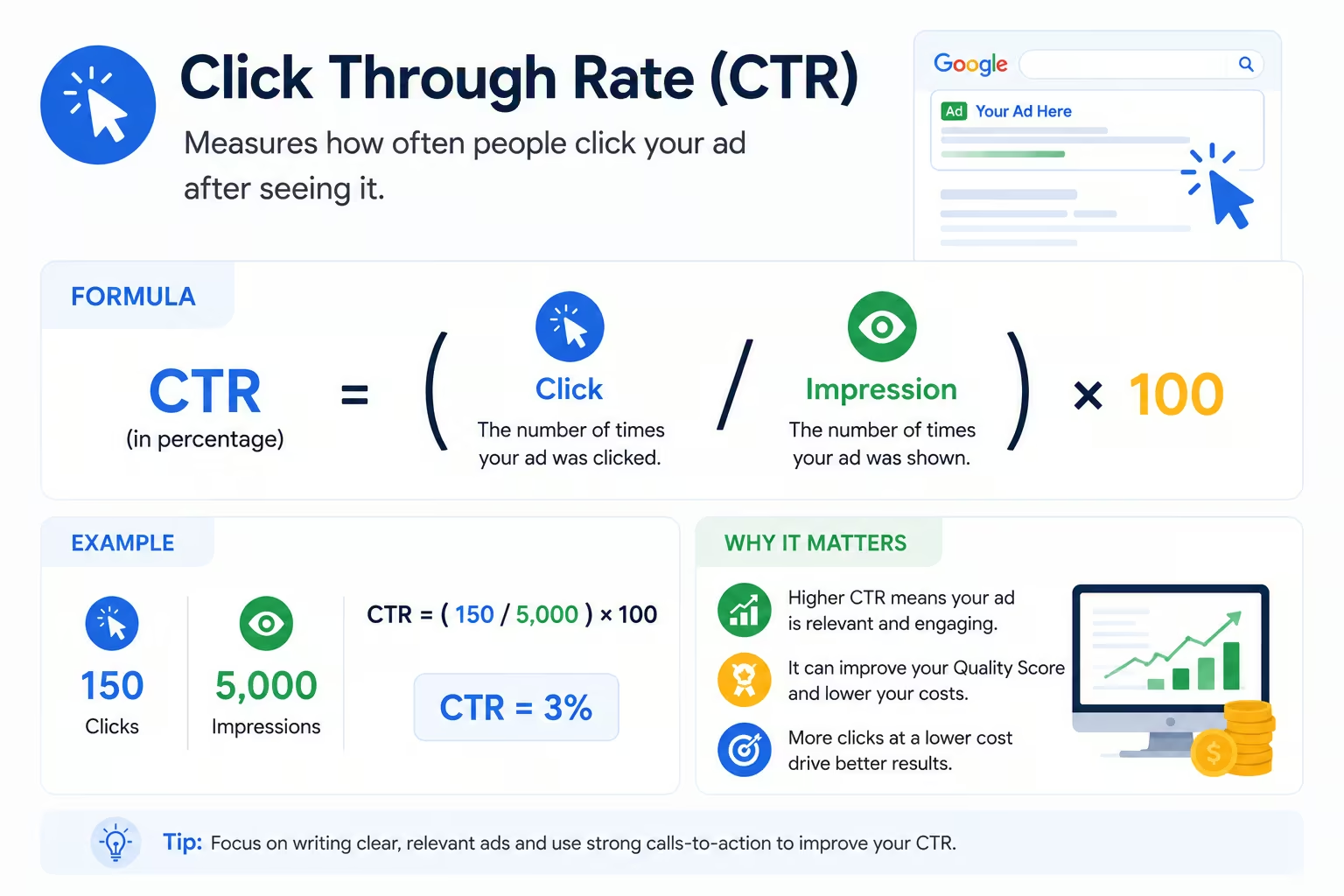
A high CTR indicates your ad copy resonates well with the audience’s search query.
- Quality Score: A diagnostic tool rated from 1 to 10 that Google uses to measure the quality and relevance of your keywords, ads, and landing pages.
- Ad Rank: The value used to determine your ad position on the search page and whether your ads will show at all.
How the Google Ads Auction System Actually Works
At a high level, Google Ads is relatively simple: businesses create advertisements and select the types of searches, audiences, or placements they want to target. When users perform relevant searches, Google decides whether those advertisements should appear. Behind the scenes, however, what happens in a fraction of a second is a highly sophisticated, real-time auction.
Many new advertisers incorrectly believe that the company with the largest budget automatically wins the top spot. In reality, Google prioritizes user experience and relevance. The platform calculates your Ad Rank using a dynamic formula:

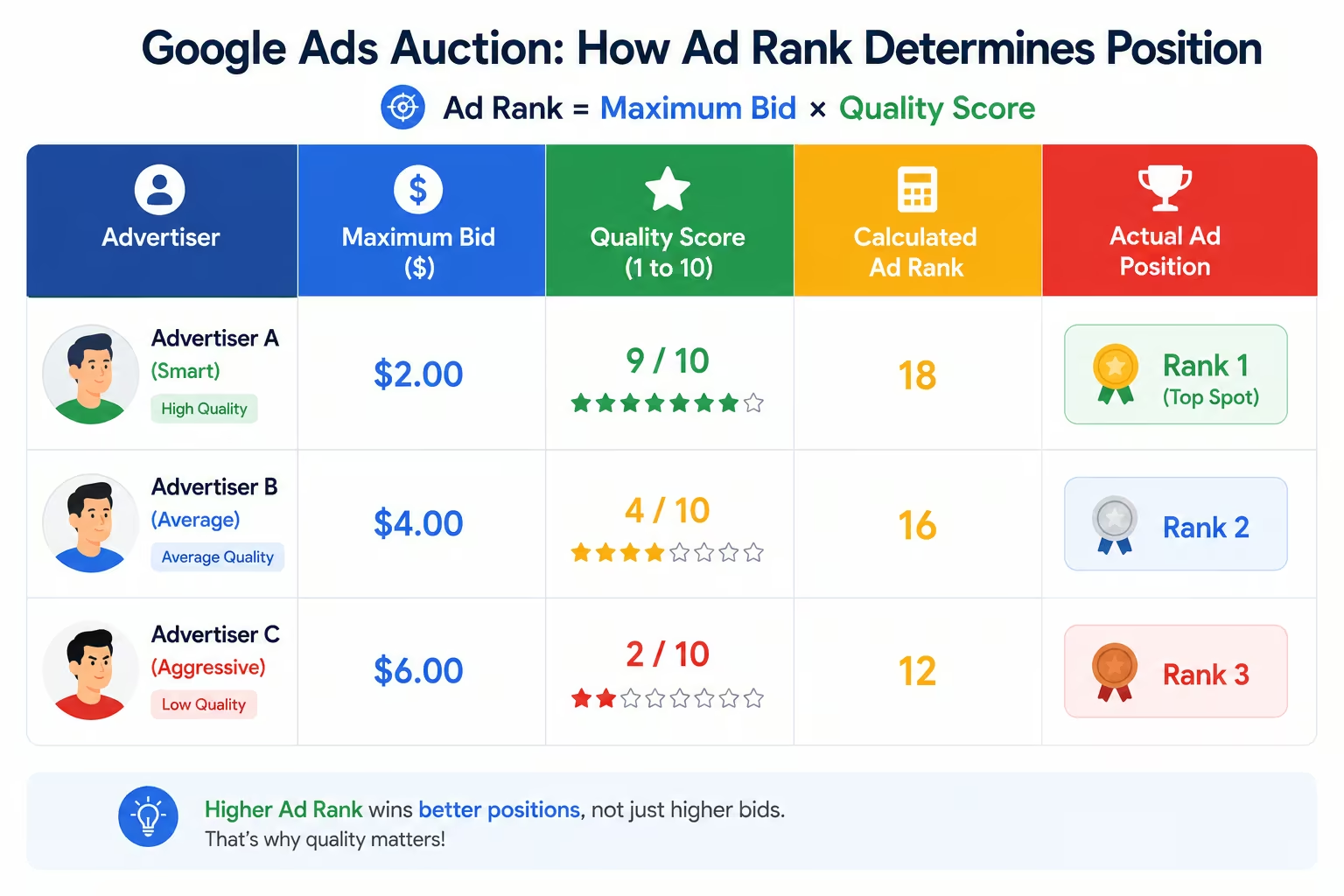
Because of this system, a highly relevant advertisement directing users to an optimized, fast-loading landing page can easily outperform competitors spending significantly more money. This equity is the primary reason small and medium-sized businesses can successfully compete against massive corporations within the same digital marketplace.
Where Your Ads Can Appear: Main Campaign Types
When people hear the term Google Ads, they often think only about classic text-based search results. While search advertising is certainly the most recognizable placement, it is only one part of a much larger network. Google provides distinct campaign types tailored to different stages of the consumer journey.
1. Search Campaigns
These are text ads that appear on Google search results pages when users look for specific queries. They are highly effective for capturing high-intent traffic from users ready to take immediate action.
2. Display Campaigns
These are visually driven image or banner ads placed across the Google Display Network, which encompasses millions of websites, news portals, and blogs. Display ads are typically used for building brand awareness and remarketing to previous website visitors.
3. Video (YouTube) Campaigns
Video ads run before, during, or after videos on YouTube and across Google’s video partner sites. They allow businesses to tell compelling visual stories and capture attention on the world’s largest video platform.
4. Performance Max (PMax) Campaigns
Performance Max is an AI-driven, all-in-one campaign type that allows advertisers to access all Google Ads inventory (Search, Display, YouTube, Maps, Discover, and Gmail) from a single campaign. It utilizes automated bidding and asset optimization to maximize conversions based on your specified goals.
Why Search Intent Matters
One of the biggest reasons Google Ads performs exceptionally well compared to social media advertising channels is search intent. Not every website visitor has the same level of interest or readiness to purchase. Consider how user intent shifts across these three distinct queries:
-
“What is cloud storage” ➔ The user is looking for basic information. (Top of Funnel – Awareness)
-
“Best cloud storage software for business” ➔ The user is evaluating and comparing available options. (Middle of Funnel – Consideration)
-
“Buy cloud storage software” ➔ The user is at the bottom of the funnel, ready to make a purchase decision. (Bottom of Funnel – Conversion)
Google Ads allows businesses to position themselves strategically throughout this entire decision-making process. The closer a search query is to a buying decision, the more valuable that visitor becomes to your business. This is why a meticulous keyword strategy, precise audience targeting, and clean campaign structures have such a massive impact on performance.
The platform itself does not generate demand; instead, it helps businesses capture the consumer demand that already exists in the market. To navigate these complexities and build a flawless keyword architecture, partnering with a full-service digital marketing agency ensures you capture high-intent traffic without wasting your budget.
Is Google Ads Only for Large Companies?
A common misconception is that Google Ads only works for enterprise organizations with massive monthly budgets. In practice, thousands of local and boutique small businesses rely on Google Ads every single day to fuel their growth.
Because campaigns can be controlled at an incredibly granular level, you are never required to compete nationwide if it doesn’t align with your business infrastructure. A local dental clinic may advertise exclusively within a 5-kilometer radius of its physical location, a law firm may focus strictly on a specific regional service area, and a home services company may target only the specific neighborhoods it serves.
The ultimate key to success isn’t the size of your budget; it’s whether there is sufficient search volume for your offering and whether you have a functional process for converting those clicks into paying customers. If you want to ensure your budget is utilized efficiently without guesswork, partnering with a professional Google Ads management service can help optimize your setup from day one.
What Makes Some Campaigns Successful?
If two competing companies advertise for the exact same service, why does one generate highly profitable returns while the other loses money? The answer rarely comes down to the advertising platform itself. Successful Google Ads accounts are rarely perfect from day one; instead, they evolve through continuous testing, refinement, and ongoing optimization.
Highly profitable campaigns consistently share five core characteristics:
- They target precisely defined audiences and negative keywords.
- They align ad copy directly with genuine user search intent.
- They communicate an undeniable, clear value proposition.
- They direct visitors to dedicated, high-converting landing pages rather than a generic homepage.
- They measure meaningful business outcomes (like leads and revenue) rather than vanity metrics (like impressions).
What Google Ads Can and Cannot Do
Understanding the inherent strengths and limitations of the platform is critical before allocating your marketing budget.
Google Ads is exceptionally efficient at generating quick market visibility, validating new product offers, acquiring scalable leads, testing new geographic markets, and uncovering high-value search behaviors.
However, Google Ads cannot fix fundamental operational business problems. It cannot compensate for poor customer service, it cannot solve a weak product-market fit, and it cannot automatically turn a slow, confusing, or ineffective website into a high-converting sales asset. Businesses frequently blame the advertising platform for poor ROI when the underlying conversion issue actually exists elsewhere in the customer journey. The most effective paid campaigns are always supported by strong offers, seamless websites, and crystal-clear conversion paths.
Google Ads and SEO: Competitors or Partners?
Many businesses approach Google Ads and organic Search Engine Optimization (SEO) as competing, mutually exclusive strategies. In reality, they perform best when deployed together as complementary partners.
SEO focuses on building sustainable, long-term organic authority, which takes time to develop. Google Ads provides immediate, highly targeted access to your audience. While a new SEO strategy may take months to generate meaningful organic traffic, an advertising campaign can begin generating visibility and leads within hours of launch.
Conversely, relying entirely on paid advertising creates a perpetual dependency on ad spend—the moment you stop paying, your traffic drops to zero. Mature businesses use both channels strategically: advertising generates immediate revenue and uncovers high-converting keywords, while SEO builds permanent, compounding visibility over time. Together, they provide a balanced, resilient digital acquisition ecosystem.
How to Get Started with Google Ads: A 5-Step Framework
Transitioning from theory to execution doesn’t require mastering every advanced feature at once. To set up your first campaign correctly, focus on this foundational roadmap:
- Create and Configure Your Account: Set up your Google Ads account and immediately deploy the Google Tag on your website to ensure accurate conversion tracking.
- Define Your Objective: Choose a specific business goal within the platform (e.g., Sales, Leads, or Website Traffic).
- Conduct Intent-Driven Keyword Research: Identify the exact search terms your customers use, and group them into tightly themed ad groups.
- Craft Compelling Ad Copy: Write clear headlines and descriptions that directly address the searcher’s problem and feature a strong call to action (CTA).
- Set Your Budget and Bidding Strategy: Start with a comfortable daily budget and an automated bidding strategy focused on clicks or conversions while your account gathers data.
Is Google Ads Worth It for Your Business?
The ultimate question is not whether Google Ads works—the data has long proven that it does. The better question is whether it aligns cleanly with your current business model, localized market demand, and customer acquisition infrastructure.
For businesses operating in industries with active, high-intent search demand, Google Ads can easily become your most measurable, predictable, and scalable marketing channel. For businesses launching entirely new, disruptive concepts that consumers don’t even know to search for yet, alternative top-of-funnel channels may yield better initial results.
Success depends far less on the platform itself and much more on how accurately you match human behavior. Businesses that deeply understand their audience, ruthlessly track conversion outcomes, and continuously optimize their campaigns based on real-time data will always find Google Ads to be a powerful engine for business growth.