If you have spent any time researching Google Ads costs in Dubai, you have likely encountered the exact same superficial metrics repeated across dozens of generic marketing blogs. Some baseline reports claim that the average cost per click (CPC) in the United Arab Emirates hovers around AED 3. Others counter with the assertion that premium search terms routinely breach the AED 50 threshold. For every guide that suggests testing the waters with a modest monthly allocation of AED 1,000, there is an agency operator asserting that you must inject a minimum of AED 10,000 before your ad account can clear Google’s machine-learning thresholds.
The structural flaw with these arbitrary figures is that none of them actually resolve the precise question that high-growth business owners are asking. Entrepreneurs and marketing directors are not deploying capital merely to discover the wholesale price of a user click. They are trying to reverse-engineer a predictable, scalable customer acquisition model. They need to know the exact financial baseline required to generate high-intent inquiries, qualified pipeline leads, and high-lifetime-value paying clients within the unique economic landscape of Dubai.
This is the exact junction where standard Google Ads pricing guides completely collapse. In a hyper-competitive ecosystem like the GCC, it is entirely common to observe two direct competitors targeting identical keywords, operating within the exact same geographical radius, and deploying matching ad budgets—yet one organization generates an influx of highly profitable sales inquiries while the other burns through thousands of dirhams with absolutely nothing to show but a high bounce rate.
The dividing line between paid search dominance and capital liquidation has almost nothing to do with the static CPC benchmarks published online. Instead, it depends entirely on structural campaign efficiency, conversion engineering, and deep search intent alignment, serving as a critical discovery pillar within your broader strategy for PPC advertising in Dubai.
Why Most Google Ads Cost Estimates Are Wrong
When auditing legacy Google Ads accounts for enterprise brands and scaling SMEs in Dubai, we consistently diagnose a recurring operational blind spot: an obsessive, isolated focus on upfront traffic costs. A business owner will frequently initiate a consultation because their average cost per click feels unsustainably high, or because a surge in competitor density has driven up bidding thresholds across their primary keyword categories. There is a pervasive market sentiment that Google Ads has simply mutated into an “expensive” channel reserved exclusively for conglomerate budgets.
However, once we execute a deep-dive forensic audit of the ad account’s historical data, we rarely discover that the raw cost of search traffic is the root cause of financial inefficiency. More often than not, the true point of failure is the post-click architecture. A campaign that excels at capturing raw user attention is not inherently built to capture a qualified business opportunity. This distinction is critical because Google does not sell closed contracts; it operates a programmatic auction for targeted human attention. Your business buys a click under the strategic assumption that your digital infrastructure can transform that click into a validated lead, a booked consultation, or an immediate online transaction.
If your post-click conversion framework is weak, unoptimized, or misaligned with the user’s exact psychological intent, even the cheapest traffic in the world transforms into a massive financial drain. We routinely review ad accounts that successfully acquire thousands of monthly visitors via ultra-low CPC phrases, yet produce near-zero qualified inquiries because the landing page experience is completely broken. Conversely, we manage highly optimized frameworks that intentionally bid on premium, high-cost transactional keywords—paying significantly more on a per-click basis—yet yield a drastically lower Customer Acquisition Cost (CAC) because the traffic is engineered to convert. For this reason, any discussion about Google Ads expenditure must abandon surface-level CPC metrics and focus entirely on downstream profitability.
🔗 Master the foundational mechanics: Explore the complete technical architecture and auction mechanics we broke down in our comprehensive guide on what is google ads.
What Actually Determines Google Ads Costs In Dubai
Dubai has solidified its status as one of the most hyper-competitive digital advertising battlegrounds in the global market. Whether your enterprise operates in luxury real estate brokerage, specialized private healthcare, corporate legal counsel, premium company formation, or international migration consulting, you are not merely competing against local players; you are bidding against global entities that are willing to sacrifice short-term margins to secure a foothold in the UAE market. However, raw competitor density is only one variable in the overarching pricing equation.
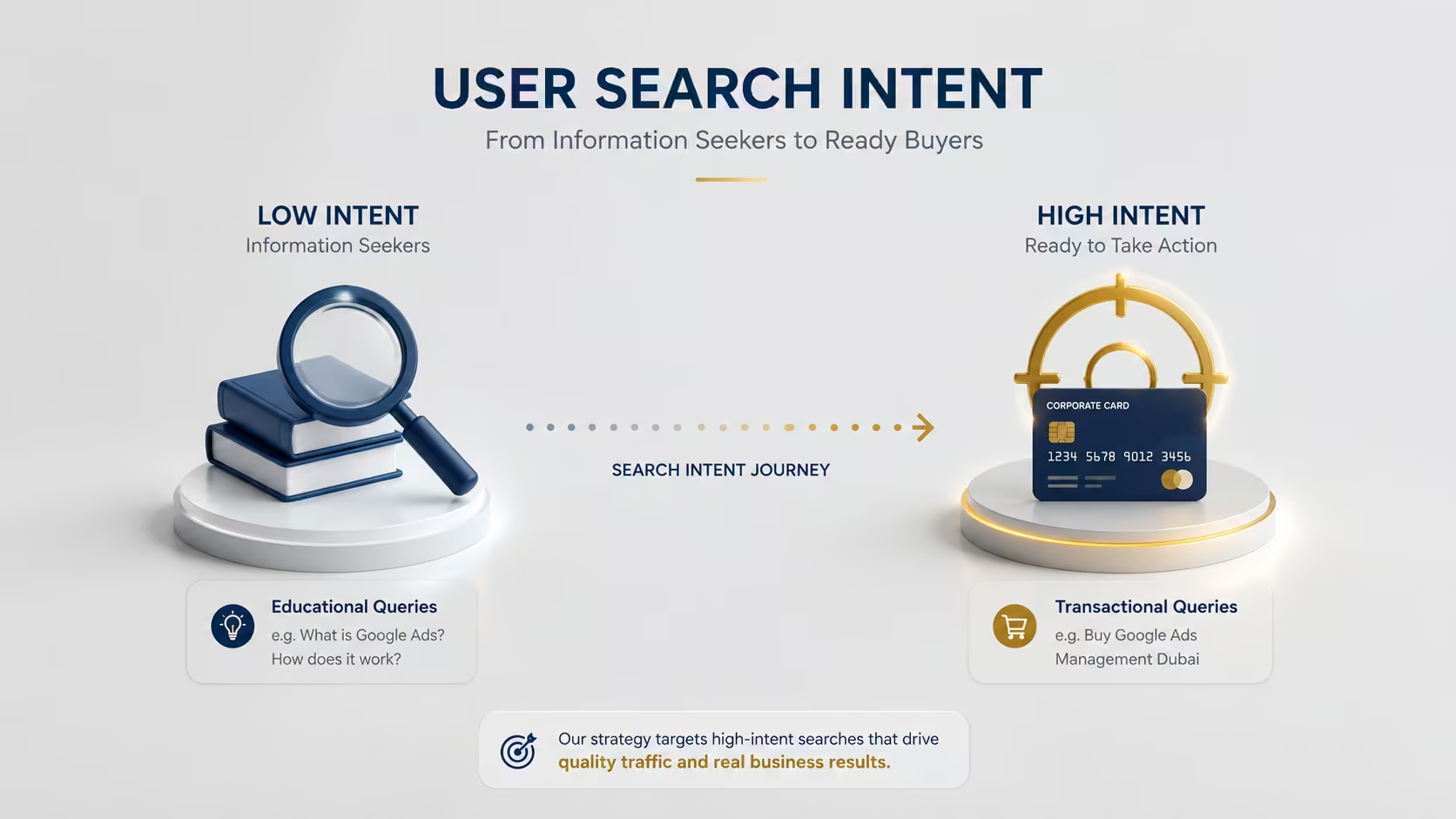
The primary catalyst of Google Ads pricing structures is the deep psychological nuance of search intent. It is a fundamental marketing error to treat all keyword impressions equally. Consider the massive operational chasm between these two search queries:
-
Informational Intent: A user searching for “what is company formation in Dubai” is navigating the top of the marketing funnel. They are searching for educational resources, translating to low commercial readiness. Bidding heavily here results in high click volumes but incredibly low conversion rates.
-
Transactional Intent: A user executing a search for “business setup company Dubai” has bypassed the discovery phase entirely. They are holding a corporate budget, actively comparing service providers, and prepared to sign a contract.
Because this second variation represents an immediate bottom-of-funnel transaction, every specialized Google Ads service in Dubai aggressively bids on it, naturally driving up its auction value.
Beyond search intent, the macroeconomic realities of your specific industry vertical dictate auction behavior. A corporate services firm or a premium B2B asset management consultancy only needs to close a handful of enterprise clients per year to generate millions of dirhams in contract value. Because the lifetime value (LTV) of their acquired customer is remarkably high, these advertisers can comfortably justify bidding AED 100 or more for a single high-intent click.
Finally, Google’s internal programmatic algorithmic evaluation engine—specifically the Quality Score framework—exerts a massive, invisible control over what you actually pay. Many business owners function under the false impression that Google Ads is a simplistic, pay-to-play auction where the highest financial bidder automatically commands the top position on the SERP. In reality, Google calculates a dynamic metric known as the Quality Score (graded from 1 to 10), which analyzes expected click-through rates (CTR), precise ad copy relevance, and the conversion engineering of your post-click landing page. A beautifully optimized campaign can achieve top-tier SERP positioning at a significantly lower cost than a competitor who bids double the money but directs traffic to a slow, unoptimized homepage.
Why CPC Can Be A Dangerous Metric
In the realm of digital analytics, a declining average cost per click is a seductive vanity metric. It feels intuitively efficient, it creates a highly polished aesthetic on monthly reports, and it gives stakeholders the comforting illusion that their ad budget is being stretched across a vast sea of consumers. Unfortunately, optimizing an ad account purely for the lowest possible CPC is one of the most reliable ways to insulate your business from actual revenue growth.
To understand the operational danger of isolated CPC evaluation, imagine two distinct campaigns running simultaneously in the Dubai market. The first campaign generates traffic at a highly efficient CPC of AED 5, while the second campaign navigates a much heavier bidding landscape, paying an average CPC of AED 20. Most traditional marketers would immediately classify the first campaign as the superior asset.
However, if the AED 5 traffic is generic and only converts 1% of its visitors into sales inquiries, your true Cost Per Lead (CPL) sits at AED 500. If the premium AED 20 campaign targets absolute bottom-of-funnel transactional intent and converts at a high-performance rate of 12%, its true CPL drops to AED 166.60.
Suddenly, the “expensive” traffic becomes dramatically more profitable. This scenario plays out across the Dubai digital ecosystem every single day. The most profitable, high-yielding Google Ads frameworks we architect are rarely the ones that boast the cheapest click metrics. They are the highly disciplined, razor-focused campaigns designed to aggressively hunt down the lowest possible cost per qualified lead. Google Ads is fundamentally an acquisition architecture, not a basic traffic generation panel.
Real-World Proof: Optimizing the Post-Click Funnel
Instead of relying on theoretical concepts, let’s examine how shifting focus from raw traffic volume to conversion intent functions in the actual Dubai market. When we audit underperforming accounts, the solution is almost never to increase the budget, but rather to realign how that budget interacts with search intent.
Case Study Preview: Shifting Focus to High-Intent Corporate Leads
A prominent corporate services and business setup provider in Dubai approached us after their qualified lead volume completely plateaued. On the surface, their campaign was highly active—generating substantial click volume and consistently spending its daily caps. However, the account was heavily prioritizing broad informational keywords, effectively paying a premium to subsidize general audience awareness while starving high-intent, bottom-of-funnel search queries.
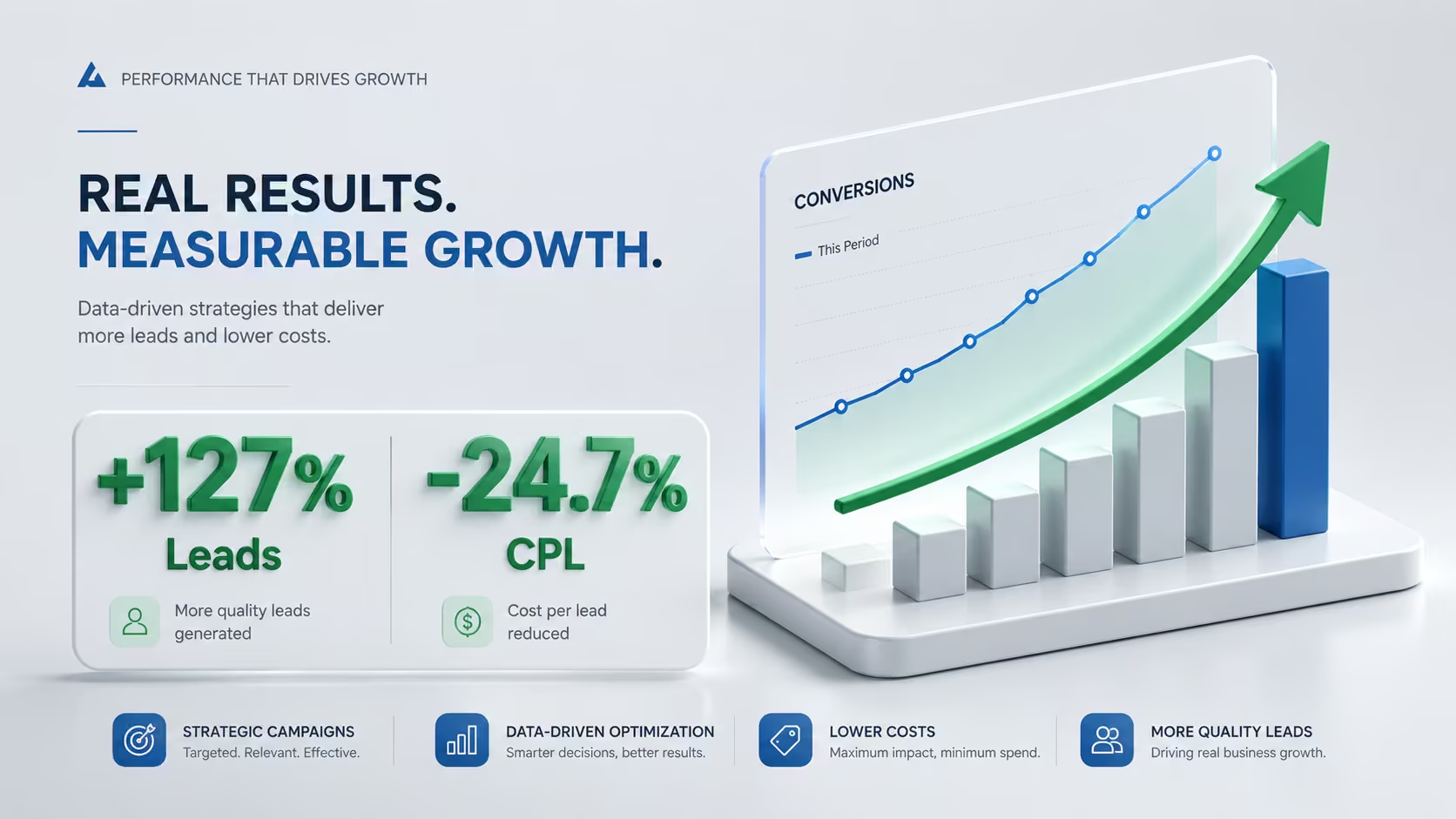
By systematically pruning waste, restructuring match types, and eliminating post-click conversion friction on their dedicated landing pages, we fundamentally altered their acquisition metrics:
-
Total Conversions: Increased by 127% within 45 days.
-
Cost Per Lead (CPL): Decreased by 24.7%.
-
Conversion Rate: Jumped by 35.7% across targeted ad groups.
🔗 Want to see the exact execution strategy? Read the full, step-by-step breakdown of how we restructured this campaign in our official Business Setup Provider Case Study.
How To Calculate Budget Based On Lead Targets
To build a sustainable Google Ads framework in Dubai, you must abandon the practice of picking an arbitrary monthly spend. Commercially viable budget planning requires a data-driven, reverse-engineered calculation anchored in your actual macro business objectives.
Let us unpack the exact mathematical progression required to calculate a mathematically sound PPC budget, comparing two distinct businesses that share an identical target goal of securing 30 validated, high-quality sales leads per month:
-
The Low-Conversion Framework (5% CR): To secure 30 leads, this website requires 600 targeted clicks ($30/0.05 = 600$). If the average industry CPC sits at AED 10, the required monthly ad spend is strictly AED 6,000.
-
The High-Performance Framework (10% CR): By optimizing the post-click experience and landing page copy, the conversion rate climbs to 10%. Now, the exact same lead target only requires 300 clicks ($30/0.10 = 300$). At the same AED 10 CPC, the required monthly budget drops to AED 3,000.
This mathematical modeling exposes why setting a budget based purely on external market averages is a deeply flawed strategy. Two brands can operate within the exact same auction, targeting the identical audience pool at the same AED 10 CPC, yet one brand requires double the marketing capital simply to achieve the exact same baseline sales volume. When you optimize the post-click experience, your reliance on high traffic volumes drops immediately.
Why Some Companies Pay More And Still Win
One of the most persistent misconceptions held by traditional business owners is that victory within paid search environments belongs exclusively to whoever possesses the deepest pockets. In the modern, machine-learning-driven landscape of Google Ads, brute financial force is no longer a guaranteed path to market dominance. The most successful advertisers in Dubai are not winning because they spend more money; they are winning because they make exponentially better algorithmic and strategic decisions with their capital.
High-performance advertisers execute their campaigns with a level of surgical discipline that amateur accounts completely lack. They abandon high-volume, generic keywords that generate empty impressions in favor of precise intent mapping. They layer historical user data, localized geographic rings, and household income brackets to filter out low-value traffic. Most importantly, their landing pages are built entirely around the psychology of user action rather than subjective brand aesthetics.
This distinct operational separation creates a fascinating marketplace anomaly: a sophisticated brand deploying a highly optimized budget of AED 20,000 per month will frequently out-convert and unlock a significantly lower Customer Acquisition Cost than a disorganized competitor blindly pumping AED 50,000 per month into the exact same category.
Case Study Preview: Eliminating Vanity Traffic for Specialized Services
We observed an identical structural failure when auditing a global migration and international corporate visa campaign targeting high-income professionals in the UAE. The legacy account was generating massive monthly click volumes and maintaining high visibility across the SERP. However, because the keyword targeting was overly broad, it treated casual educational researchers identically to qualified, high-net-worth individuals ready to invest in relocation solutions. The campaign was buying massive amounts of digital curiosity, but zero business momentum.
We executed a total structural reconfiguration—implementing strict household income (HHI) filters, restricting match types strictly to long-tail transactional intent, and engineering sequential retargeting funnels to re-engage qualified prospects.

The strategic reallocation of capital completely shifted their performance baseline:
-
Validated Conversions: Scaled upward by more than 120% within a single intake cycle.
-
Cost Per Lead (CPL): Dropped by approximately 35%.
🔗 Discover the technical framework: Explore the precise audience layering and architecture blueprints we used in our official Migration Solutions Case Study.
When Google Ads Becomes Expensive
Businesses often describe Google Ads as an inherently expensive marketing channel. In many cases, their assessment is completely accurate—but almost never for the reasons they think. Google Ads does not become expensive because of high competitor bids or rising base costs within the auction platform.
Google Ads becomes expensive when campaigns continue spending without generating meaningful, actionable data. It becomes expensive when you allow broad match types to match your ads with completely irrelevant search queries. It becomes expensive when you direct premium paid traffic to a corporate homepage that takes five seconds to load on a mobile device and lacks a clear value proposition. It becomes expensive when your conversion tracking is inaccurate, leaving your team to make critical decisions based on blind assumptions rather than verified data.
High cost-per-click metrics do not inherently threaten your profitability. We routinely engineer and oversee campaigns navigating premium click costs of AED 60 or more that generate extraordinary financial returns because the backend monetization model is perfectly calibrated. Conversely, we have audited accounts capturing incredibly cheap clicks at AED 1.50 that lose substantial amounts of money month after month because the traffic possesses zero transactional intent. Poor decision-making is expensive; precision-engineered digital acquisition is an investment.
How We Approach Budget Planning
When a new enterprise client approaches us to audit their digital presence and asks exactly how much they should allocate to Google Ads in the Dubai market, our initial diagnostic process never begins with an arbitrary financial figure. We firmly reject the practice of relying on generic third-party keyword planning estimators or baseline industry averages. Instead, our strategic planning begins with a thorough deep-dive into the core unit economics of your business model.
We guide our clients through a rigorous framework of discovery questions designed to expose the true financial drivers of their acquisition funnel:
-
How many validated, sales-ready inquiries does your internal sales team need each month to hit their baseline growth targets?
-
What is the exact average financial value and long-term lifetime value (LTV) of a closed customer within your business model?
-
Out of every ten marketing leads generated by your digital systems, how many are successfully converted into signed contracts or paying clients?
-
What is the absolute maximum sustainable Cost Per Acquisition (CPA) your unit economics can absorb while maintaining healthy operational profit margins?
Only after we have mapped out these internal business benchmarks do we begin projecting ad spend allocations. The ideal marketing budget is never dictated by external market consensus; it is mathematically determined by the internal economic realities of your business.
Google Ads Cost vs Google Ads Profitability
The phrase “Google Ads cost” consistently dominates global search volume metrics because it is the intuitive question that business owners naturally type into Google when researching customer acquisition. However, after collaborating with brands across dozens of high-stakes industries in the UAE, we have established that shifting the executive conversation away from basic costs and toward systemic profitability is the single most important step in unlocking long-term scaling potential.
A framework that drives a massive volume of cheap, top-of-funnel clicks is not inherently superior to a highly restricted campaign that drives a small volume of premium, high-intent transactional visits. A campaign that saturates the market with impressions is completely useless if those impressions fail to convert into qualified pipeline opportunities. And maintaining a low, restricted monthly budget under the assumption that you are saving corporate capital is actually costing your business millions in lost revenue if it prevents your brand from capturing ready-to-buy market share. The businesses achieving the strongest results tend to focus on acquisition efficiency, conversion quality, and net revenue generation rather than vanity metrics.
Should You Manage Google Ads Yourself?
For some businesses, managing campaigns internally makes perfect sense. At an early validation phase, the primary risks are small, and the absolute cost of operational mistakes is relatively low. However, as your sales goals expand and your monthly ad budgets scale past critical thresholds, the technical complexity of modern performance marketing inevitably creates an artificial growth ceiling for internal generalist teams. Once you are deploying significant amounts of capital into a hyper-competitive auction market, partnering with an experienced digital marketing agency in Dubai prevents the massive financial penalties associated with amateur configuration.

Managing a high-performance modern ad account requires mastering an array of highly specialized disciplines, from algorithmic bidding optimization (Target CPA vs Target ROAS) to advanced data attribution and server-side tracking validation. At this professional tier, Google Ads management transforms into a rigorous exercise in statistical analysis, conversion engineering, and corporate strategy. The core objective is no longer simply about keeping ads running on a screen; it is about building a highly predictable, automated pipeline that turns marketing spend into corporate profit.
Next Step: Get A Custom Cost Projection
Relying on generic internet tables and third-party benchmark guides will only take your business planning so far. They cannot provide an accurate answer for how your specific brand should deploy capital, because they possess zero visibility into your local competition, your internal conversion infrastructure, your unique sales cycle, or your target growth metrics.
If you are ready to evaluate Google Ads as a primary, predictable customer acquisition engine for your business, the next step is to step away from generic industry generalizations and map out a precise, custom strategy. Explore our Google Ads Management Service to see exactly how campaigns are structured, or review our pricing page for a clearer understanding of typical investment levels. Stop evaluating your marketing through the narrow lens of what Google Ads costs. Let’s partner to determine exactly how much revenue your campaigns can generate.